
Feature Story – San Diego State University Athletics

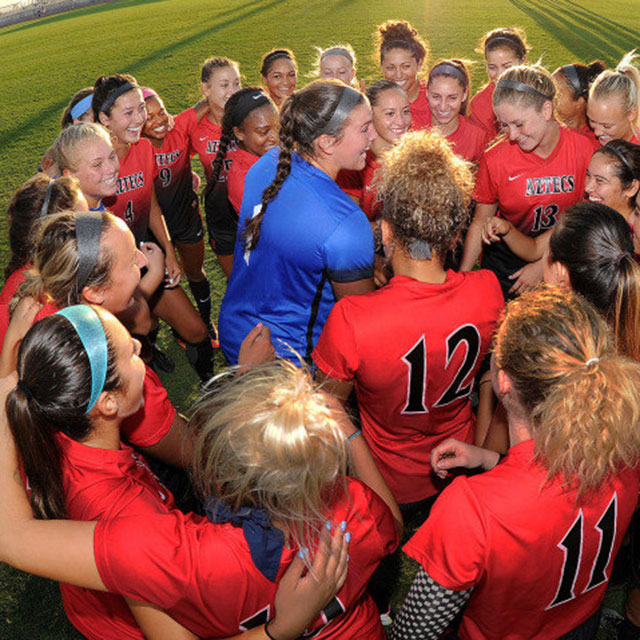
Aztec Women's Soccer SDSU

Aztec Women's Soccer SDSUSan Diego State University has one of the top athletic programs in America and all SDSU students, including ALI students, get free admission to the football and basketball games, as well as all other athletic events on campus.

Since the 2010-11 school year, the Aztecs have the third-best combined record in the country for their men’s basketball and football teams.

The basketball team played 11 straight seasons in postseason games in the National Collegiate Athletic Association (NCAA) and National Invitational Tournament (NIT) tournaments, which are reserved for the top teams in America. SDSU, which sells out every home game at the 12,414-seat Viejas Arena has twice made the prestigious Sweet 16 in the NCAA Tournament (meaning it’s among the top 16 out of more than 350 universities).

In football, the Aztecs play in their seventh straight bowl game in December 2016 or early January 2017. These games are primarily for teams that win at least half of their games during a season. SDSU plays at Qualcomm Stadium, the same site as the San Diego Chargers of the National Football League.

In the last four sports seasons, the Aztecs won 32 conference championships, more than any other in the 12-team Mountain West Conference. The Mountain West teams come from an area that spans about 3,400 miles (more than 5,400 kilometers) from Hawaii to the Rocky Mountain region of Colorado and Wyoming.

Here are some other facts about SDSU athletics:

  • Women’s soccer won three out of the last four Mountain West Conference championships before this season
  • Women’s softball made the NCAA Tournament nine straight seasons until 2016, and won at least 30 games in 11 straight seasons
  • Women’s golf earned a place in the NCAA Tournament six of the last seven years
  • Women’s water polo finished among the top eight in America last season
  • Men’s baseball played in the NCAA Tournament three straight years before 2016. Its stadium is named after former coach Tony Gwynn, who died in 2015 and is in the Major League Baseball Hall of Fame.
  • Men’s golf finished among the top five teams in the nation last spring
  • Ashley Henderson of SDSU finished second nationally in the NCAA Outdoor Track and Field Championships last spring
  • Fourteen members of the women’s swimming and diving team were named to the all-Mountain West Conference team for finishing in the top eight during the finals

On top of it all, SDSU set a school record for the second straight year with 72 student-athletes earning Mountain West All-Academic honors for the spring 2016 semester. This year’s spring total surpasses the old record of 69, which was set in spring 2015.

To be eligible for selection, student-athletes must have completed at least one academic term at SDSU while maintaining a cumulative grade-point average of 3.0 (B or better), and be a starter or significant contributor on their team.
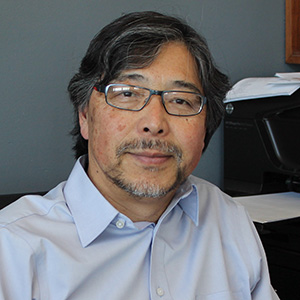

Former ALI Student is Now Director of SDSU’s School of Art and Design

When Kotaro Nakamura came from Yokohama to learn English at SDSU’s American Language Institute (ALI) in 1977, he thought he’d be on campus for a couple years before going back to Japan.

Nearly four decades later, he’s still on campus now, as the director of SDSU’s School of Art and Design.

After passing the TOEFL test through ALI, Nakamura became a graduate student at the School of Art and Design from 1978-80. A professor convinced him to stick around for a year and complete his practical training by teaching.

“At that point, I planned on going back to Japan,” he said. “Then I met a girl on campus and decided to stay.”

The girl, Katherine, was an English major. She and Nakamura have been married 36 years.

“This is not how I planned it,” he said. “Things happened that way. I had planned on going back to Japan to be with my friends and family. In hindsight, I’m very lucky to be here.”

Nakamura remembers coming to the ALI when classes were held in a two-story apartment building near the former SDSU student health center, which was across Campanile Drive from the modern Gateway Center that now hosts the ALI.

“The teachers were great,” he said. “They really cared about students. They helped you make the transition from a foreign student to a native speaker. I appreciated their care.”

Their nurturing extended beyond the classroom. Nakamura noted that his teachers even helped him with tasks such as using a checkbook.

Nakamura came to SDSU before the days of the internet, discovering the campus through a Tokyo travel agency brochure. He said he was attracted to the university because of its environmental design program.

When Nakamura arrived at SDSU, he could not speak English even though he had studied the language for several years through middle school, high school, and three years at a Japanese university.

“The Japanese education is based on reading and writing, not speaking,” he said. “I hung around Japanese students and spoke Japanese because I was scared. My English became much better after I met my girlfriend.”

Even after all these years in San Diego, Nakamura sometimes wonders what life back in Japan would have been like for him.

“Once in a while, I do get to go back,” he said. “My friends there seem so old. It’s a very tough life in Japan. The stress level there is much higher versus San Diego.”

Nakamura advanced to the level of interim director at SDSU’s College of Art and Design in 2013, and became the permanent director in 2015.

Outside of SDSU, Nakamura is the owner of RNT Architects, an architectural design and master planning business.

“My teaching and practice feed off each other,” he said. “What I teach in the classroom is directly influenced from my practice. If I was just teaching, I wouldn’t learn what is going on in the practice of design.”

Nakamura also reaches out to advanced level ALI students at their orientation to enroll in regular courses on campus.

“I tell the students that I was once one of them,” he concluded. “It’s interesting to look at the students and see myself from years ago.”

Feature Story – San Diego State Ranks Among Top Universities in America

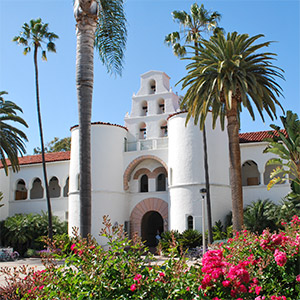
SDSU's Hepner Hall

SDSU's Hepner HallWhen students worldwide attend the American Language Institute (ALI) at San Diego State University, they are enrolling in an institution that ranks high in America for its achievements and distinctions.
SDSU is currently ranked in the top 150 national universities and in the top 80 public universities, according to U.S. News & World Report’s annual ranking of America’s Best Colleges.

Additionally, SDSU’s international business undergraduate program is ranked No. 10 in the nation and several graduate programs are standouts in their fields. They include rehabilitation counseling (No. 9), speech language pathology (No. 25), clinical psychology (No. 26), audiology (No. 27), nursing midwifery (No. 29), and public health (No. 30).

SDSU’s campus is a hub of student invention and innovation, led by the Lavin Entrepreneurship Center and the Zahn Innovation Center. FORBES magazine ranked SDSU No. 23 on its list of America’s Most Entrepreneurial Universities.

The Carnegie Foundation classifies SDSU as a doctoral-granting institution with high research activity funded by the National Institutes of Health and the National Science Foundation. Undergraduate students have many opportunities to work with faculty mentors on exciting projects in SDSU’s campus labs and research centers.

For the second consecutive year, SDSU was selected a recipient of INSIGHT Into Diversity Higher Education Excellence in Diversity Award. The national honor recognizes U.S. colleges and universities that demonstrate outstanding commitment to diversity and inclusion. U.S. News and World Report ranked SDSU in the top 20 nationally for ethnic diversity.

In addition, SDSU ranks No. 22 in the nation for the number of students studying abroad, in the latest Institute for International Education’s Open Doors report. More than 2,100 students have international experiences each year, choosing from nearly 400 programs in 52 countries.

On the local level, Aztec Athletics unites the San Diego community. In 2014, SDSU teams won nine Mountain West Conference championships. The football team competed in a fifth consecutive bowl game, ranking it among only 29 universities nationwide that have taken part in such a prestigious game each of the last five years. The men’s basketball team earned a spot among the top 16 in the nation twice in the last five seasons, and Shanieka Thomas won two NCAA triple jump titles – the fourth and fifth national titles for SDSU track and field in the last three years.

All in all, SDSU is a great place to attend for students from any country.

ALI Students Give Back to the Community

Community Service Volunteer

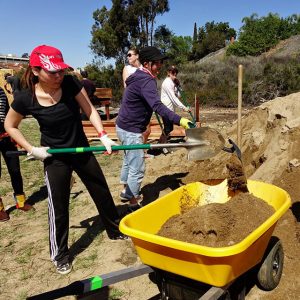
Community Service VolunteerStudents at the American Language Institute (ALI) come to San Diego State University to improve their English language skills and prepare themselves for success in the future. Before returning home, many choose to give back by participating in community service projects.

Victor Alsaeed from the small Middle Eastern country of Qatar is a perfect example.

Alongside other ALI students, he has participated in activities ranging from serving food to residents at St. Vincent de Paul Village to picking up coastal debris with I Love A Clean San Diego to filling planter boxes at the College Area Community Garden.

All the while, Alsaeed said he is giving as well as taking back. In the process of doing community projects, ALI students are also working closely with Americans and learning how to improve their English through verbal communication with fellow volunteers.

“As Martin Luther King had a dream, we have a dream to speak English as American students,” Alsaeed said. “It’s my pleasure to serve the community. It’s a good use of your time. It helps with your speaking and listening, too.”

Among his favorite outings was the Aztec Unity Project. Planned by SDSU Student Life and Leadership, the program involved volunteering with fellow ALI and main campus students at the Salvation Army Kroc Center’s Boo Bash. The group spent half a day organizing Halloween-themed activities for local families and children.

“I made new friends; not just ALI students but San Diego State students,” Alsaeed said. “It’s a good way to break the ice. ALI students are sometimes shy to speak English. We stayed close to the SDSU students and learned how to speak the same language.”

Eun Hee Cho from Korea is another example of an ALI student helping out in the San Diego community. She has taken part in many of the same projects as Alsaeed.

“I like the saying ‘No man is an island.’ If there is somebody who needs help, I want to share what I have. I also want to keep our nature clean for the community and for the next generation,” Cho said.

She also spent a weekend as part of the Aztec Unity Project where ALI students joined their peers from the main campus cleaning up trash from the banks of the San Diego River. The day before their clean-up effort, the group participated in a series of team-building exercises to ensure their work together would be enjoyable.

“I participated in the Aztec Unity Project for the same reason as other projects; I wanted to help the community. The only difference was that we discussed our project after volunteering,” she said.

Alan Schuchman, the ALI Student Life Coordinator, oversees the volunteer program. He said that the ALI takes its inspiration from SDSU’s five-year strategic plan and its aim to be a good neighbor to the surrounding community.

Starting in spring 2015, ALI students will receive recognition on their program certificates for volunteering on a consistent basis, he noted.

“It’s heartening to see our students take the extra step to help others,” he said. “They’re not just students in school; they’re engaging with all kinds of people and