
Feature Story – San Diego State Ranks Among Top Universities in America

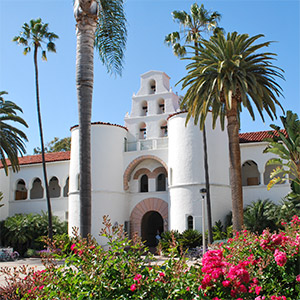
SDSU's Hepner Hall

SDSU's Hepner HallWhen students worldwide attend the American Language Institute (ALI) at San Diego State University, they are enrolling in an institution that ranks high in America for its achievements and distinctions.

SDSU is currently ranked in the top 150 national universities and in the top 80 public universities, according to U.S. News & World Report’s annual ranking of America’s Best Colleges.

Additionally, SDSU’s international business undergraduate program is ranked No. 10 in the nation and several graduate programs are standouts in their fields. They include rehabilitation counseling (No. 9), speech language pathology (No. 25), clinical psychology (No. 26), audiology (No. 27), nursing midwifery (No. 29), and public health (No. 30).

SDSU’s campus is a hub of student invention and innovation, led by the Lavin Entrepreneurship Center and the Zahn Innovation Center. FORBES magazine ranked SDSU No. 23 on its list of America’s Most Entrepreneurial Universities.

The Carnegie Foundation classifies SDSU as a doctoral-granting institution with high research activity funded by the National Institutes of Health and the National Science Foundation. Undergraduate students have many opportunities to work with faculty mentors on exciting projects in SDSU’s campus labs and research centers.

For the second consecutive year, SDSU was selected a recipient of INSIGHT Into Diversity Higher Education Excellence in Diversity Award. The national honor recognizes U.S. colleges and universities that demonstrate outstanding commitment to diversity and inclusion. U.S. News and World Report ranked SDSU in the top 20 nationally for ethnic diversity.

In addition, SDSU ranks No. 22 in the nation for the number of students studying abroad, in the latest Institute for International Education’s Open Doors report. More than 2,100 students have international experiences each year, choosing from nearly 400 programs in 52 countries.

On the local level, Aztec Athletics unites the San Diego community. In 2014, SDSU teams won nine Mountain West Conference championships. The football team competed in a fifth consecutive bowl game, ranking it among only 29 universities nationwide that have taken part in such a prestigious game each of the last five years. The men’s basketball team earned a spot among the top 16 in the nation twice in the last five seasons, and Shanieka Thomas won two NCAA triple jump titles – the fourth and fifth national titles for SDSU track and field in the last three years.

All in all, SDSU is a great place to attend for students from any country.
ALI Student Profile – Oleksandr Iakovenko

Oleksandr Iakovenko
Oleksandr Iakovenko
Oleksandr Iakovenko

Oleksandr Iakovenko has always been into adventures of his own and others.

Growing up, the Ukraine native enjoyed skiing and snowboarding in his homeland and several surrounding countries.

Then, after attending a private Ukrainian university as a business administration major, he went to work as a manager in the airline business.

His adventure from there? He is enrolled in the pre-MBA program at the San Diego State University American Language Institute with hopes of one day obtaining his business MBA.

“After years of working, I realized that I needed more knowledge for my career,” he said. “I observed information on the Internet and found that the ALI pre-MBA and pre-Master’s programs are among the best in the United States. That’s why I came here.”

Oleksandr plans to return to his Ukrainian home, located about 40 kilometers (25 miles) from the Russian border, after attending one semester at ALI. His goal is to work back home for several months, then return to America and enroll in an MBA program, possibly at SDSU.

“The university here is very nice, especially the campus and the teachers” he said. “The teachers are the best feature of the program; they are great. Everyone here is really kind and willing to help students.”

Among other items, Oleksandr has been pleased with how much ALI instructors have helped him with his English pronunciation and grammar. He speaks four languages: Ukrainian, Russian, English, and French.

According to Oleksandr, he has been helped greatly being surrounded in his classes by students from more than 20 countries such as Brazil, South Korea, Saudi Arabia, and China.

“It has been very useful to exchange stories and ideas with students from other countries,” he said. “It’s a different approach; it’s more than just learning from books.”

No matter where his career takes him, there are certain to be many more adventures for the Ukrainian student.

Program Spotlight: Social Entrepreneurship Students Hold Fundraiser to Help People Worldwide

Social Entrepreneurship Fundraiser

Social Entrepreneurship FundraiserAccording to Paloma Gouveia, “the thing we need most now in the world is compassion.”


A Brazilian student in the groundbreaking Social Entrepreneurship (SE) certificate program at SDSU’s American Language Institute, she was among 20 classmates who spread compassion during the summer semester.

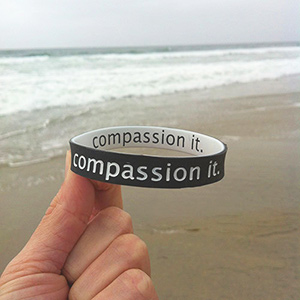
Through the selling of Compassion It bracelets, the SE students raised $1,000 to help the following individuals make their dreams become reality:

  • A farming woman in Armenia growing fruits and vegetables
  • A single mother in Colombia developing her own clothing shop
  • A fisherman in the Philippines buying additional nets and accessories for his boat
  • A woman in Kenya purchasing a dairy cow

“If I explain to someone what social entrepreneurship is, I will use the Compassion It fundraiser as a perfect example,” Gouveia said. “You care about others, think about good actions, and share all the love you have. In doing so, you help others live their lives in a better way.”

Sara Schairer, founder of San Diego-based Compassion It, provided the bracelets at a reduced cost for the SE students’ fundraiser. Her organization is a nonprofit global-social movement that inspires compassionate actions and attitudes.

The Compassion It bracelets are intended primarily for fundraisers. At an affordable cost, communities, schools, businesses, and even families can raise money using the bracelets,  influence positive behaviors through a pass-it-on ripple effect, and have an impact of peace and mindfulness that affects everyone.

All money for the initial purchase of wristbands is recycled back into Compassion It operations and programs, including compassion education, communication efforts, and, of course, producing more wristbands that will travel the globe.

The four gifts provided by the SE fundraiser were made possible through Kiva, a nonprofit organization whose mission is to connect people through lending to help alleviate poverty. Kiva enables individuals to lend as little as $25 to create opportunity around the world.

Students participating in the SE fundraiser were from Brazil, Columbia, Italy, Japan, Saudi Arabia, South Korea, Taiwan, and Turkey.

The Compassion It bracelets were black on one side and white on the other. Students began the day with the bracelet showing its black side. Once they performed a compassionate act, they would flip their bracelet from black to white. Compassionate acts included volunteering, providing food/money to a homeless person, helping an elderly person across the street, placing coins in a parking meter that was almost expired, sending someone flowers, and taking a fellow classmate to the airport, among other things.

“In the history of mankind, too many people just answer the world’s problems by saying, ‘who cares?’” noted Italian student Matteo Marchisio. “Now, social entrepreneurship gives a possible way to stop this thinking.”

Kelly Shah, ALI social entrepreneurship program director, said the summer fundraiser took place for several reasons: providing students with social involvement, practicing English with a purpose, the business aspect of learning to pitch an idea, and having a real-life occurrence.

“We were looking for something outside of the classroom to provide a great experience for our students,” she said.

The SE program focuses on creating businesses that solve social problems. A prime example is TOMS Shoes, which matches every pair of shoes purchased with a pair of new shoes for a person in need.

Students are each creating a project along social entrepreneurship lines. For instance, Gouveia enjoys photography and is putting together a website to sell her photos, with part of the profit being donated to animal institutions and zoos. Marchisio has developed a plan to sell a sci-fi book he has written with a portion of the income being donated to a foundation focused on fighting illiteracy.

“I studied TOMS Shoes and really appreciated the organization’s attempt to help people,” he said. “I am trying to fight a social disadvantage and help people who need it.”

TESL/TEFL – Changing Your Life Can Change Many Other Lives

Alicia Wszelaki, TESL/TEFL Certificate Graduate

Editor’s note: The ALI will be updating its student profiles twice monthly to let you know what some of our former students are doing today. Here is the original blog on Alicia Wszelaki, along with a look at her current status.

Alicia Wszelaki, TESL/TEFL Certificate GraduateIf you’re like most people, you are probably wondering how you can travel the world, make a difference, and still make a living doing so. One way to see the world and pay the bills is through teaching English overseas. A way to start is completing a TEFL certificate program. This program focuses on the development of effective and innovative teaching methods for an international classroom, with the added benefit of helping graduates find jobs overseas.
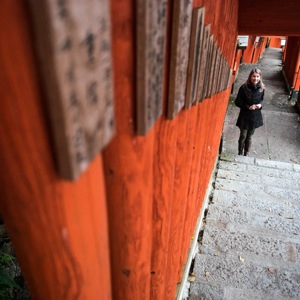
Alicia Wszelaki completed the TESL/TEFL program at SDSU’s American Language Institute (ALI), then traveled the globe teaching English. She shares her experiences here.

The Program
The program teaches you how to be a teacher. They prepare you to go someplace where you are a foreigner and now you have to become a part of that culture. So the program goes over, not only the essentials of how to teach students a language, but also how to be a part of, and respect that culture. You learn methodologies about teaching and you go through a lot of the theories. This helps you not only in the classroom, but also outside the classroom since you’re communicating everywhere that you go.  I recommend the program at ALI to anybody thinking of changing their career because it gives you a chance to change yourself too, to challenge yourself. The program builds a lot of confidence in people. Before I took it, I was totally afraid to speak in front of a group of people. It became my vehicle to change my life.

Best Candidates for Success
I think the program is a great opportunity for somebody who is willing to take a challenge and willing to step out of their safety role. The program can be for everyone. And I think, in general, if someone is looking into the program, they already have what it takes to go because they’ve already thought about it. Somewhere the seed has been planted and they have what it takes to do it.

Change Your Life
I feel like I started again. I felt like I was going to school for the first time and I really wanted to be there. It empowered me to go out and do something different. Those four weeks really changed my perspective and gave me a lot of confidence. I think that’s the main thing. I think the program gives you confidence because I’ve never taught before. They give you everything that you need; all of the tools. In the morning, you’re in the classroom, then in the afternoon you are in another classroom where you’re actually watching a teacher firsthand and you are interacting with the international community.

Proudest Moment
I was teaching in Japan. I had a group of about 30 kindergartners. Teaching kindergartners involves a lot of songs and activities. There was one girl that would sit in the back of the room and stare at me. She didn’t sing a word, she didn’t clap her hands, she didn’t do ‘head, shoulders, knees and toes;” nothing. I didn’t know how to break through. Then one day the girl was screaming at the top of her lungs. Every single word that I ever taught in the class – every single word to every single song, and doing all the motions. I was like, “Wow, everybody gets it when they’re ready to get it.”

Advice
Just do it. It’s a bit scary to change your life, to say I’m going to leave everything behind and try this without having a safety net. It’s so easy once you do it. People want everything answered for them when they go abroad and start teaching. And sometimes, you just can’t do that because everybody is going to have a different experience. Answers will come when you get there. Put yourself out there and everything will come to you. I encourage anybody to try the program, because even if you never leave the country, the program gives you tools to being a successful communicator. In our country, you still have to work with international people, so even if you don’t step outside or get a stamp in your passport, the program still makes you change.

UPDATE ON ALICIA

Alicia WszelakiWhat is your current occupation?

I’m owner of Path 88 Productions, a media production company located in San Diego. In addition to producing documentaries, we specialize in photography and video projects for the travel industry, corporations, and private businesses. Some of our recent films include, Camino The Journey to Santiago and Long Distance.

We understand you are doing a documentary on a Japanese woman who ran an English newsletter for 30 years. Please tell us about that.
Our latest film, The Newsletter, tells the story of a group of women in Kure, Japan who for the last 30 years have published Parkway, an English-language newspaper with global readership. It is a tale of passion, friendship and how life happens between the lines.

This short documentary is a direct result of taking the TESL/TEFL program at the American Language Institute. It is through my time teaching in Japan that I was introduced to the staff of Parkway, who asked me to be their English editor, a position that I have enjoyed since 2008.

You have traveled the world since you were an ALI student. How much of a factor was the TESL/TEFL program in getting you started as a globetrotter?
Being a graduate of the TESL/TESFL program has given me added confidence to travel.  It has opened up opportunities to work and live in other countries. Since my graduation in 2003, I have had the chance to visit, live, work, and teach in over 30 countries.

Do you continue to stay in touch with any of your former classmates or the staff at ALI?
There is a bond with individuals who make the decision to become ESL instructors, whether they stay at home or travel abroad. Teachers share an underlying sense of adventure and a desire to make a difference in people’s lives. It inspires and motivates me to know that my closest friends are the ones I have met abroad and at the ALI.

Do you still consider the TESL/TEFL program a life changer?
Taking The TESL/TEFL program at ALI started a chain of events that have led me to where I am today. I frequently travel the world and interact with various cultures. I tell other people’s stories through photography and motion pictures; my passions. Would this have happened without the course? No. A life Changer, Yes! And thank you.

Becoming an Expatriate. ALI: The Keys to the Kingdom.

Zachary York

By Zachary York

Zachary York
Zachary York

My transition into a professional life from that of academia is riddled with twists and turns, as it is for most people that I know. Throughout my undergrad at the University of Arizona, I studied creative writing and the Italian language. It was there that I got my first taste of being abroad; study abroad in Italy was an eye-opening experience.

After I completed my degree, I sought direction and took to the open road. I backpacked around Europe for two months with my best friend. It was somewhere on our train journey through Italy and France that I decided to return to school and pursue a master’s in Special Education.

I found a program at SDSU and made quick work of taking the prerequisite courses. During said courses, I was afforded the opportunity to take a short internship at the Western Academy of Beijing, where I gained firsthand experience in international classrooms, building scaffolding for the students with different learning styles.

During some off time, I was able to observe an ESL/ EFL class; I was bitten by the bug. When I returned to the U.S. after what seemed like a couple days but in actuality was five weeks, I switched my focus to Teaching English as a Foreign language. It just so happens that SDSU has the American Language Institute (ALI) and I started to get my things in order so I could start the program.

Among those things was the realization that the trailhead in front of me was the culmination of my language education and my desire to elevate the everlasting itch for all things foreign, to paraphrase Melville. Most of all, however, this job utilizes my empathetic personality and strong drive to help people.

This is where I played my hand and committed to studying at the ALI; easily one of the best choices of my young life. The curriculum included everything that will start me on my path to become a global educator and to expatriate-hood. One of the best parts, in my opinion, was the mentorship program. I have always aligned myself with those from whom I can learn. The mentorship program was just what I needed to build that personal bridge in-between what I was learning and the production stage. I first started having an academic mentor in high school; haven’t looked back. This type of relationship really works for me and my style of learning.

With the wide program of classes offered by the ALI, I now step forward to my job at a local school in the land of 1000 smiles [Thailand] with a strong confidence and preparedness. I was able to utilize the network I cultivated here in America to build a relationship with the powers that be at that school, in addition to some expatriates in other countries.

John Dewey said, “To find out what one is fitted to do, and to secure an opportunity to do it, is the key to happiness.” ALI has given me those opportunities and, helped me to hone my focus to embrace my itchy feet.

As I look forward into the very near future of my adoption of an expatriate lifestyle, I see many tasks and hoops to jump through. But as the time draws close and my ducks get in their rows,

I am afforded a view of my new home: the Far East. This lifestyle has always been one that I dreamt of adopting and, I credit the ALI with helping me to find the tune which makes my heart sing.

Follow Zachary York’s expat adventures at zacyork.wordpress.com

ALI Instructor Profile – Theresa Perales

Theresa Perales
Theresa Perales
Theresa Perales

Theresa Perales, an instructor at SDSU’s American Language Institute (ALI), is always on the move.

“I like to stay active,” she said. “I am constantly doing something.”

She runs up to 10 marathons or half-marathons annually and works out every day whether it be running, yoga, spinning, you name it.

“It’s just who I am at this point,” Perales said. “Whether or not I got enough sleep or am tired, I am out the door running or doing yoga. It’s like how we all just eat or breathe. I just do.

“I love running. Once I get out there, I get a running high. There is no coordination involved. I am only competing against myself.”

When it comes to running, it all goes back to when she was a student at SDSU several years ago. She cheered on friends one day at the yearly Rock ‘n’ Roll Marathon in San Diego then said to herself it was time to do the same.

Ironically, Perales was not into athletics while she attended University of San Diego High School (now Cathedral Catholic.) She focused solely on academics, taking advanced classes in preparation for college.

Perales went to SDSU, earning both undergraduate and master’s degrees in Spanish. While attending her master’s program, she went to the Rock ‘n’ Roll marathon to cheer on friends and had her life turned around from exclusively focusing on academics to including a multitude of athletic adventures.

Raised by her grandparents, she was also adventuresome while growing up. Her grandparents loved to hop in the RV and take summer trips to such places as the Great Lakes region, Ohio, and Buffalo, N.Y.

The travel bug stayed with Perales in college as she twice participated in study abroad programs to Costa Rica. She took her boyfriend (now fiancé) on the second trip, hoping to show him a place where they may someday retire.

During her time at SDSU, she enrolled in ALI’s TESL/TEFL Certificate program that prepares novice instructors to successfully live and teach English overseas. She became a facilitator (teacher’s aide equivalent) at ALI in 2008 and has been teaching since.

Perales currently teaches in the EAP (English for Academic Purposes), Intensive English for Communication (IEC), and TESL/TEFL Certificate programs. This summer, she is also working as the Fulbright pre-academic program coordinator for an exclusive group that comes to SDSU in August. The three-week Fulbright training program through ALI is designed for students from countries other than the U.S., and is formatted to introduce them to American culture, university standards, and fair practices.

Working with international students is one of the main reasons Perales enjoys the ALI, which is located close to main campus. She welcomes being able to take her students across the street to meet native-English speakers.

“I like the students first and foremost,” she said. “I love their diversity. Working at the ALI, I have the opportunity to grow in so many different ways.”

Perales and her fiancé, both fans of the San Diego Padres and Chargers, are about to grow in another way as they have become first-time homebuyers. They are do-it-yourselfers when it comes to home improvement projects and working on their cars.

She had a Chargers key chain at the old residence but realizes the team could soon be headed to Los Angeles.

“I don’t want them to leave,” she said. “If they do, I don’t want to be stuck with that key chain.”

Unlike the Chargers, she has no plans of leaving her current employment location any time soon.

Feature Story – Around California

ALI Students in San Francisco

ALI Students in San FranciscoWhen students attend the American Language Institute (ALI) at San Diego State University, they are going to school at a beautiful location in California with many fun places nearby to visit.

Lots of students love to visit the beaches that stretch for miles. For an entire day of activity, they may also visit such tourist attractions as the San Diego Zoo, Sea World, Safari Park, and Legoland California.

There are numerous other places within driving distance in California, including Los Angeles (two hours away) and San Francisco (about an eight-hour drive).

Las Vegas, Nevada, a popular tourist destination, is about a five-hour drive. The Grand Canyon in Arizona is within a long day’s drive.

The ALI offers many trips to its students through various local companies. Aztec Adventures on the San Diego State campus also hosts numerous excursions.

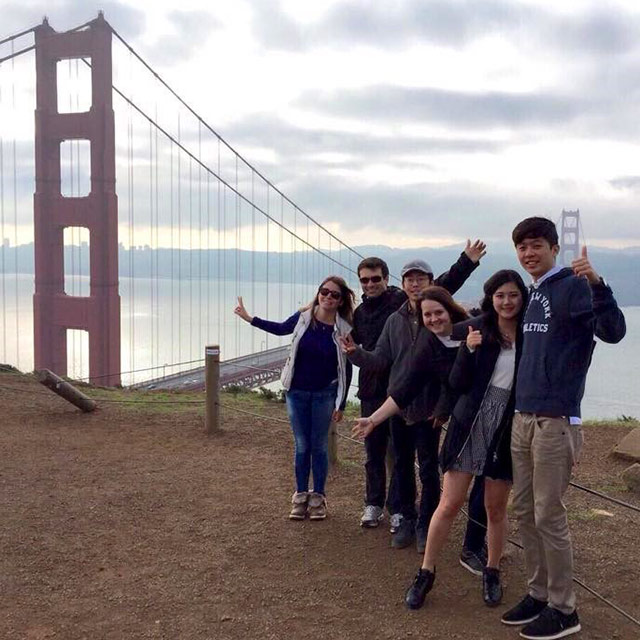
ALI Students at the Grand CanyonALI student Natalia Mityushina, an International Business English (IBE) student from Russia, drove to San Francisco along with five friends from the ALI. She described her group as “six people in one car with jokes, music, long talks, and fun, fun, fun!”

“San Francisco is one of the most beautiful cities in the world,” she said. “It’s small, but has its own charisma and style. It’s not like other American cities; it’s more European. Also, in San Francisco you can find a lot of stuff to do and to see like the Golden Gate Bridge and Pier 39. Just to walk around is nice, and you see lots of colorful districts.”

Her group also enjoyed riding the cable car (an open train trolley). She said it was interesting to stand up all the way while riding the cable car.

Natalia added that a big part of the adventure was the car trip. “I totally recommend to do a road trip through California State Route 1. It’s an amazing route: the road runs between the ocean and mountains.”

Sibel Can Uzun from Turkey, an IEC/IBE student, took the short drive to Los Angeles.

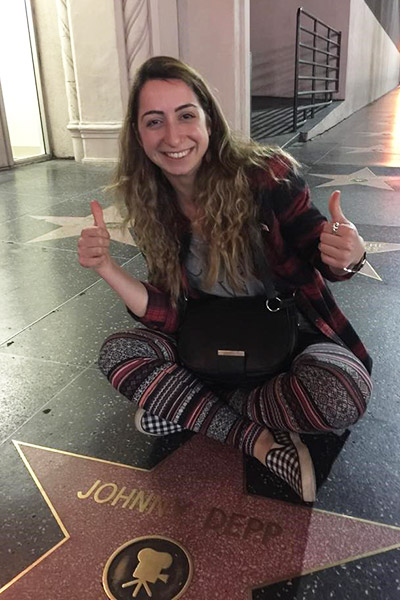
Hollywood Boulevard“When I went to LA, I was walking on the Hollywood Boulevard and everybody was taking pictures with the stars. I did the same,” she said. “Lots of people were wearing costumes like Spider-Man and Captain Jack Sparrow. My favorite was Captain Jack Sparrow because I love (actor) Johnny Depp.

“A lot of tourists were there, too, in front of the Chinese Theater taking pictures. I looked at all the famous artists’ names. It was amazing.”

Amy Sakurai is an IEC student from Japan who visited the Grand Canyon, a spectacular place to see in northern Arizona.

“I really loved the Grand Canyon,” she said. “It was so amazing. I went there with SDSU friends and spent three nights together during the Thanksgiving holiday. We talked and laughed a lot. I have a lot of good memories from there.”

The same can be said for so many ALI students who take advantage of the wonderful areas that surround San Diego, California.

Staff Profile – Chad Schempp – ALI Recruiting Director

Chad Schempp
Chad Schempp
Chad Schempp — ALI Recruiting Director

Chad Schempp has certainly been well served by tennis in his career path, and it all began by playing on a California state championship team at Vista High School.

He moved on to UC Santa Barbara, where he chose to focus on his studies and not play tennis at the collegiate level.

Even so, he still kept interested in tennis. And being at UC Santa Barbara ultimately led him to SDSU’s American Language Institute where he has been the ALI recruiting director since September.

During Schempp’s junior year of college, he participated in Semester at Sea, where students sailed around the world for five months and made stops in 14 countries. Their assignment: Explore each country for several days, come back onboard the ship and write research papers for classes concerning the country they just visited.

“I had a passion to work with international students from that point on,” he said. “That’s what has led me to my current job and related jobs.”

Upon graduating from college, he worked for a government insurance office in downtown Sydney, Australia. But the tennis bug never left him, so his next job was teaching tennis in Saipan, a commonwealth of the United States near Guam.

Schempp went from there to Japan, where he still had visions of teaching tennis on a full-time basis. But a technicality prevented him from getting a work visa teaching tennis, so he taught English to obtain his work visa and taught tennis in the evenings and on weekends.

“I started to enjoy teaching English more than tennis,” said Schempp, who worked as an associate professor at a Japanese junior college teaching and advising students who desired to study abroad.

After that, he was recruited to help create and teach at an in-house language school for 2,000 General Electric employees in Japan.

From there, it was back to San Diego County as director of an international student program at Mira Costa College in Oceanside. Around that time, he married his wife who is from Japan, so they decided to move to Hawaii in order to be halfway between their two families. While there, he worked as director of graduate admissions for Hawaii Pacific University.

The Schempps then decided to move back from Hawaii five months ago to be closer to his entire family that lives in San Diego. And speaking of family, Chad said there is nothing like the family atmosphere at the ALI.

“People here are unbelievably friendly,” he said. “I’m impressed and surprised by how long people have worked here on average. When I went to the (SDSU) staff awards luncheon, I was surrounded by fellow employees who had been here 20 years or more. People obviously enjoy it, which is great.”


ALI Student Profile – Sofia Rodriguez

Sofia Gonzalez
Sofia Gonzalez
Sofia Gonzalez

Sofia Rodriguez was assigned by an international placement agent in Mexico to attend the American Language Institute at San Diego State University. As it turned out, it was a wise choice.

“I’m glad I was able to go to school there,” said Sofia, a former student in the Intensive English for Communication (IEC) and International Business English (IBE) programs who has moved back to Mexico City.

Sofia came to the ALI hoping to improve her English speaking skills and expand her vocabulary. She said both were accomplished because of the outstanding faculty at the ALI.

“I learned a lot with them,” Sofia said. “They were really interested in teaching us the best possible way. Also, they were very accessible to answer our questions.”

While at the ALI, Sofia said she made many new friends that she still keeps in touch with.

“I use the skills I learned at ALI when I talk with my new friends,” she said. “And, I can watch movies and listen to music in English and understand more than before.”

Sofia grew up in Mexico City with a variety of interests. As a child, her favorite activities included soccer, dancing, and reading.

She was able to continue with each of these interests while at SDSU. The university has an outstanding intramural program where she played soccer, the ALI offers a dance class each Friday, and there were many reading activities available through the ALI. She also enjoyed going to such events as a football game between SDSU and the University of Idaho that featured a spectacular fireworks show afterwards.

“I liked a lot of things about San Diego State,” Sofia said. “But I think the best thing about it were all of the activities available on campus.”

In addition, Sofia found the San Diego community to her liking.

“San Diego is an awesome place,” she said. “Everything is nice … the weather, the people, the beaches. You can hang out with your family or friends. There are many interesting places to visit where you will have fun.”

Certainly, Sofia could not have made a better choice than the ALI and SDSU.

ALI Students Give Back to the Community

Community Service Volunteer

Community Service VolunteerStudents at the American Language Institute (ALI) come to San Diego State University to improve their English language skills and prepare themselves for success in the future. Before returning home, many choose to give back by participating in community service projects.

Victor Alsaeed from the small Middle Eastern country of Qatar is a perfect example.

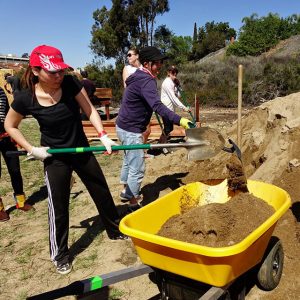
Alongside other ALI students, he has participated in activities ranging from serving food to residents at St. Vincent de Paul Village to picking up coastal debris with I Love A Clean San Diego to filling planter boxes at the College Area Community Garden.

All the while, Alsaeed said he is giving as well as taking back. In the process of doing community projects, ALI students are also working closely with Americans and learning how to improve their English through verbal communication with fellow volunteers.

“As Martin Luther King had a dream, we have a dream to speak English as American students,” Alsaeed said. “It’s my pleasure to serve the community. It’s a good use of your time. It helps with your speaking and listening, too.”

Among his favorite outings was the Aztec Unity Project. Planned by SDSU Student Life and Leadership, the program involved volunteering with fellow ALI and main campus students at the Salvation Army Kroc Center’s Boo Bash. The group spent half a day organizing Halloween-themed activities for local families and children.

“I made new friends; not just ALI students but San Diego State students,” Alsaeed said. “It’s a good way to break the ice. ALI students are sometimes shy to speak English. We stayed close to the SDSU students and learned how to speak the same language.”

Eun Hee Cho from Korea is another example of an ALI student helping out in the San Diego community. She has taken part in many of the same projects as Alsaeed.

“I like the saying ‘No man is an island.’ If there is somebody who needs help, I want to share what I have. I also want to keep our nature clean for the community and for the next generation,” Cho said.

She also spent a weekend as part of the Aztec Unity Project where ALI students joined their peers from the main campus cleaning up trash from the banks of the San Diego River. The day before their clean-up effort, the group participated in a series of team-building exercises to ensure their work together would be enjoyable.

“I participated in the Aztec Unity Project for the same reason as other projects; I wanted to help the community. The only difference was that we discussed our project after volunteering,” she said.

Alan Schuchman, the ALI Student Life Coordinator, oversees the volunteer program. He said that the ALI takes its inspiration from SDSU’s five-year strategic plan and its aim to be a good neighbor to the surrounding community.

Starting in spring 2015, ALI students will receive recognition on their program certificates for volunteering on a consistent basis, he noted.

“It’s heartening to see our students take the extra step to help others,” he said. “They’re not just students in school; they’re engaging with all kinds of people and