After working in aerospace satellite engineering for more than 20 years, Kyle and Angela Roessler were ready for a change. “We wanted a job where we can travel the world, see different places and meet interesting people,” said Kyle.
From the SDSU website, the Roesslers learned about the American Language Institute’s 130-hour TESL/TEFL certificate program, which they completed in just four weeks by choosing the intensive daytime program. (There’s also the option of 11 weeks of nighttime courses.) Two months later, the Roesslers were teaching English in Casablanca. Talk about taking action on a dream.
Kyle Roessler answered a few questions about their experience abroad.
How did the program’s free worldwide job placement assistance work?
We received lots of interesting options from the ALI assistant director of teacher training the program coordinator, but in the end we found our job in Casablanca from Dave’s ESL Café [a popular, free web resource for English as a Foreign Language teachers all over the world].
What made you choose Morocco?
We wanted somewhere we had never been and that sounded exotic. Casablanca fit those two requirements.
Where did you live?
We rented an apartment near the center of town. Our apartment was near a tram stop, as was the school, so it was easy to get to work.
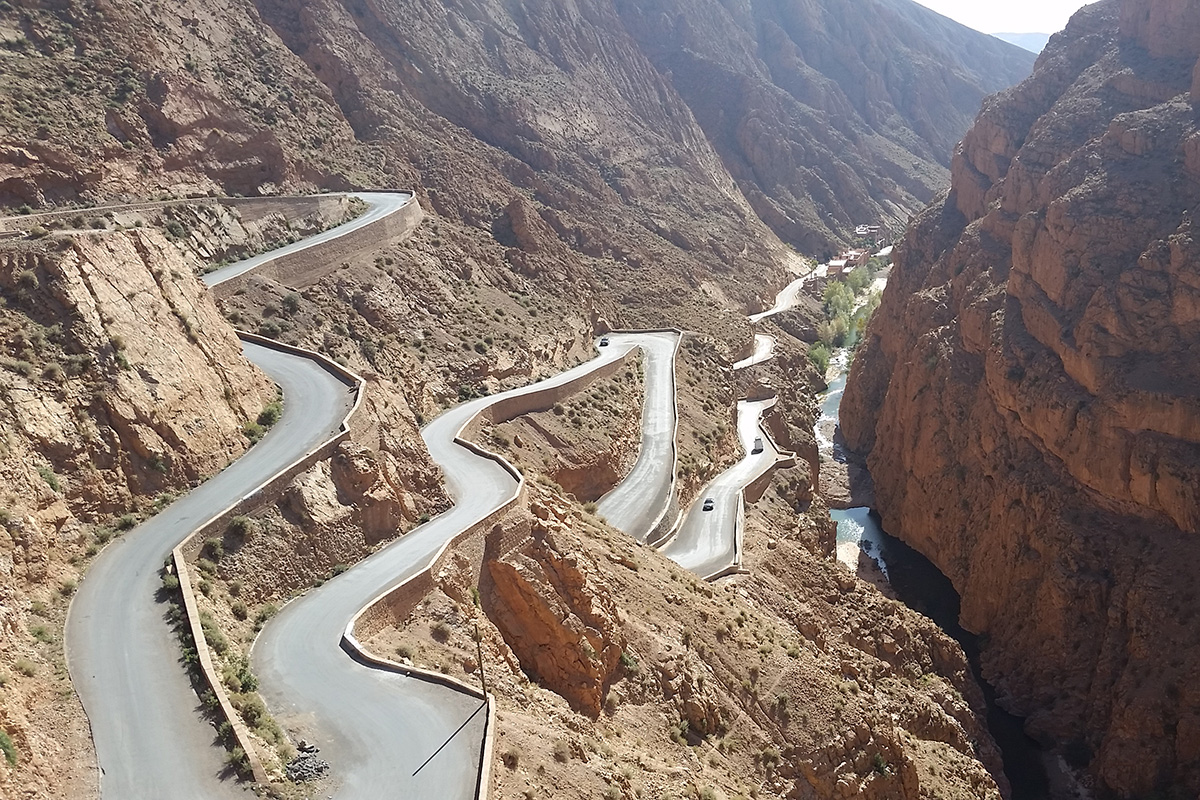
Dades Gorge, near Ouarzazate in south-central Morocco
What did a typical day look like?
We taught at all different times and in different locations, at school and at different businesses. Saturday was our busiest day when we both had three classes (two two-hour classes and one three-hour class). We taught kids aged 7–18 and adults, business English and general, and also SAT and GMAT prep. So we got a lot of different teaching experiences in our nine months.
Were there TESL/TEFL instructors from other countries at your school?
Yes, from Canada, England, Scotland, and Morocco.
Do you have anecdotes to share: small world occurrences, unexpected humor, places you explored?
The kids we worked with loved watching Mr. Bean cartoons. They’re nearly silent, so they’re easy for ESL students to understand and enjoy. Also, we had a tough time initially understanding when to get certain dishes from restaurants. Eventually, we figured out that they only serve couscous on Fridays. That was a surprise, but it fits in with how Moroccans make and serve couscous in their homes (only on Friday, too).
How was the food?
Terrific. We had couscous every Friday, Moroccan tea, and tajine — it’s usually chicken or beef cooked with a variety of vegetables over charcoal in a clay pot. Very yummy. We were in Morocco for Ramadan so got to try many of the sweets that are made especially for that season, like for Christmas.
Tell us about some of the friendships you made.
We lived in the same building as one of our fellow teachers and got to know him well. However, the most surprising friendship is with a young woman we met on the tram. She helped us get new SIM cards for our cell phones when we first arrived, and we got together for lunch about once a month. She even invited us to her parent’s house for lunch.
Hassan II Mosque in Casablanca
Was teaching abroad everything you hoped it would be?
It was interesting, it was challenging, but it was a lot of fun. We had expected to teach rich and poor alike, but we really only taught business people and kids from rich families. I am not convinced I made a difference in anyone’s life, but who can tell that right away? I only had one class where I felt like everyone was enthusiastic and really learning things; that was a great feeling and it told me I should be teaching beginners more because they are so excited to be learning something new every day. But I think a lot of those issues were due to where we chose to teach.
What do you think are the biggest strengths of the TESL/TEFL Certificate program at SDSU?
The fact we got to spend so much time in classrooms with real ESL students made me feel much more comfortable when I had a two-hour class to prepare for and run on my very first day at the school.
What words of advice do you have for anyone contemplating teaching English abroad?
Go for it! You can’t really tell if it’s for you until you try it out. And anytime you get to travel when someone else is paying you, it’s a good deal.
Anything you’d like to add?
I’m an author of four self-published novels, the most recent entitled, The Navel of the World. I’m working on a new novel that could be of interest to ALI folks because it will introduce the world to my suggestions of how English can be simplified to make it a more useful international language.
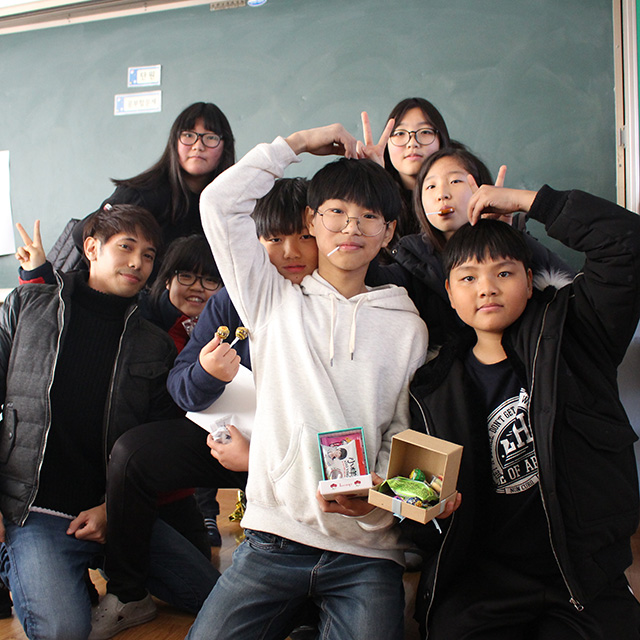
Andrew Toledo (bottom left) with his Advanced After-school English Club, in mid-Secret Santa gift-exchange.
Andrew Toledo had always wanted to teach abroad, so after he graduated from San Diego State University with a degree in psychology, he did a Google search and found that his alma mater had the very thing he was looking for — a TESL/TEFL Certificate program, through the American Language Institute.
Because he had a part-time job at the time, Toledo chose the 11-week nighttime program to complete the 130-hour certificate. (There’s also an accelerated daytime option of four weeks of intensive study.) Then he took advantage of the program’s free worldwide job placement assistance.
“It was great,” said Toledo. “I was able to get a job in South Korea on my first try. This could also be due to my facilitating experience with the Intensive English Program at the ALI, boosting my résumé and chance of getting hired.” He answered a few questions about the program, and his experience teaching English abroad.
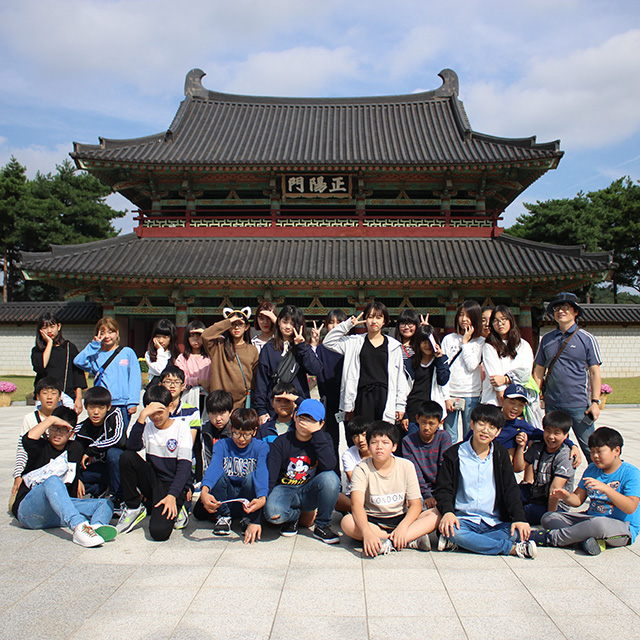
Andrew Toledo’s 6th grade students in from of the Gyeongbokgung Royal Palace in Jongno-gu, near the Seoul main district.
What made you choose South Korea?
I chose it because I somewhat studied the language independently and have several South Korean-American friends. I felt pretty comfortable with the culture and already enjoyed the food, so it was an easy choice. At first I wanted to try Taiwan, but it was quite difficult for an Asian-American to find a job there.
Why is it difficult for an Asian-American to find a job in Taiwan?
Lots of private English schools in Taiwan are still a business, so they require that “White American” look in order to sell their services to parents. I would look great on paper, however due to many CVs and resumes requiring a photo of yourself in Asia, I was turned down quite a bit. I even used my connections in Taiwan where my friend’s mother was able to ALMOST get me a job. They were in the process of hiring me, but once they saw that I wasn’t White (not fitting the American stereotype), I was quickly ghosted.
Where did you live in South Korea?
I lived in Geoje-Do, the second largest island in South Korea, just south of Busan. The island isn’t necessarily isolated from the mainland and is connected by a large bridge named Goga Daegyo. It’s an industrial island famous for its shipyards. My village (Hacheong-Myeon) was small, consisting of elders and Daewoo ship workers. It’s an old traditional farming village reminiscent of Korea in the 1980s. I invited some of my Korean friends from Seoul to my village, and they were amazed and said it looked like a movie set! Although it was quite rural, I enjoyed every single day and did not necessarily feel lonely at all. It was refreshing to see kids playing outside, elders taking walks, people using the bus system constantly, all while being surrounded by nature. It was a great mixture of nature and social life. Keep in mind it’s a village, so stores and restaurants don’t stay open very late. That being said, all I had to do was hop on a bus and head to the downtown area, which was only 15 minutes away, if I felt like having a nightlife. If I wanted to go to Busan (second largest city in Korea), I could just hop on a bus and be there in about 1 hour. By the way, buses are always on time. It’s great!
What did a typical day look like?
I would wake up at 6:30 am to have breakfast in my apartment and walk a whopping 1/4 mile to work, which started at 8:30 am. I liked waking up early because I don’t like rushing to get myself ready. I worked at three schools in three different villages. Because I built such a strong relationship with my co-workers, I was offered rides to work and didn’t need to rely on the bus for my morning commutes. My students were all elementary students with very little English skills and pure hearts. I have heard great things about rural children compared to those who live in the city, and I believe it. Although students were a little hyper and rowdy, they were interested in learning, usually respectful, and enjoyed interacting with me (both in and out of the classroom). I still wonder about them today and hope they are getting a quality education.
Were there TESL/TEFL instructors from other countries at your school?
Nope, I was the only foreigner at my school. In fact, the whole village only had two foreigners in total! It was a challenge, but my Korean language skills definitely improved and I made several South Korean friends that I still keep in touch with today.
The annual Jinju light festival.
Do you have anecdotes to share: small world occurrences, unexpected humor, places you explored?
Two years in Korea, so I have sooooo many! I’ll only report about two briefly.
1) I was there for the impeachment of Park-Geun-Hye. [Editor’s note: The 11th president of South Korea, 2013–2017, and the first woman.] It was actually illegal for me to be near protests, but you can’t stop the protest from coming to you. I was on the bus heading to Seoul when some protesting farmers decided to walk their cows on the freeway as a form of demonstration. It was interesting and I couldn’t avoid it, but it did hold up traffic and I reeeally needed to use the bathroom.
2) My first instance of homesickness was somewhere in my first two months of South Korea. My co-workers wanted to play volleyball (we played every week), but I wasn’t emotionally willing on this particular day. I had feelings of loneliness, missing home, and culturally isolated. My co-workers went outside without me and I could hear them having fun, but I stayed in my office to work on lessons to keep my mind busy. All of a sudden, I heard my name being yelled from outside. My windows were closed, so the voices were faint. I opened the window and saw my school yelling for me to come out and play. It was heart-touching and I couldn’t say no after seeing that! So I ran out and joined them for volleyball. I ended up losing because I’m terrible at volleyball, but it was worth it!
How was the food?
I love Korean food! I loved it here in San Diego, and I liked it even better in Korea! The meat was so fresh and had a distinct quality that only South Korea has. It is probably impossible to replicate here due to the way our food is processed in the U.S. My new favorite dish is a pork soup called Dwaeji-Gukbap.
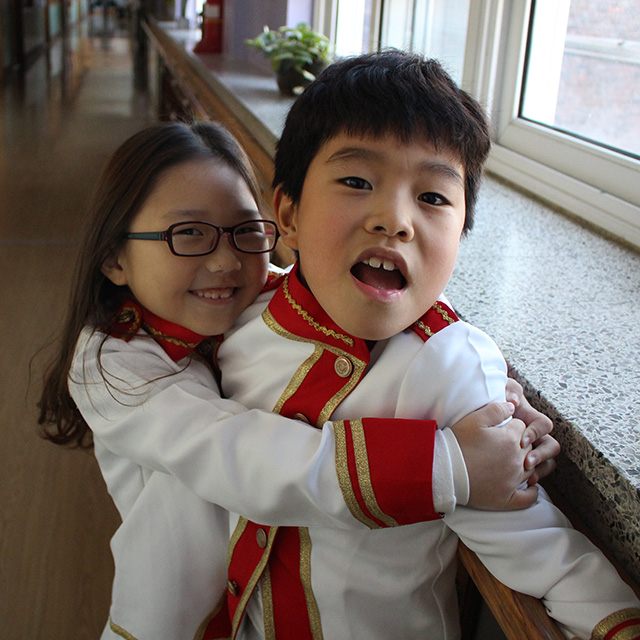
First-grade students in their music festival uniforms.
Tell us about some of the friendships you made.
So many! My co-workers, previous students I facilitated at the ALI, friends of friends, my boss from my part-time job in the U.S. and her friends, the random people I met in the cities and villages. I was quite social and enjoyed the amount of people I met. More importantly, I valued the few friends who I built strong relationships with. I still contact them to this day and we talk about visiting each other again almost every month.
What do you think are the biggest strengths of the ALI’s TESL/TEFL Certificate program?
The activities and how they support their graduates through facilitation opportunities. I have a notebook of all the different games and activities that I learned through the ALI.
What are you doing now?
I’m pursuing my M.A. in International Education at SIT Graduate Institute in Vermont. I hope to work with International students coming into the U.S., preferably at the ISS (International Student Services) center at a university. I’m in my practicum phase at the moment and will be doing a 6–9 month internship at Colby-Sawyer College in New Hampshire.
Anything you’d like to add?
Two things!
1) Reverse culture-shock is real. One way I have been battling it is through food. I learned how to cook several South Korean dishes, so I like to bring those to parties and potlucks. It’s a great way for me to re-visit my experience and show others about my experiences without feeling pretentious. Let’s put it this way, I spent two years in Korea and when someone asks “What was it like?” they’re mostly saying “tell me in less than 5 minutes.” There is no way I can do that justice, and a majority of my story and experiences cannot be told without them losing interest. The only people who understand this feeling are those who have worked/studied abroad as well. Food is a great bridge to connect others to your experiences.
2) For anyone else thinking of working in South Korea, it’s not always easy. There are social norms you must respect, many South Koreans are quite shy, and socializing takes a bit of effort. Just remember, you are a guest in a new country, and sometimes guests are scary! There will be rocky times, and times where it is smooth sailing. With effort, a good heart, and a strong will to stand back up and try again, your journey will have more positive moments than negative ones.
Ziplining at the Arii Hills Skywalk in Jeongseon, Gangwondo, Korea, after the 2016 Annual NET (Native English Teacher) Kickball event.
“Despite being successful in school and at work, and even attaining significant financial security, I never hit upon a career that seemed to fit me,” said Susan Zyphur, a 2006 graduate of UCSD. All that changed when she decided to teach English abroad. In a Google search, she found the SDSU American Language Institute, and within three months of completing the TESL/TEFL certificate program, was teaching in Korea.
“Attending SDSU’s ALI was one of the best decisions I’ve ever made, and it was the best money I’ve ever spent,” said Zyphur. “I would absolutely do it again, and I highly recommend it.”
She answered a few questions about her journey through the program, and her adventures in Korea and Japan.
Please give us a brief overview of your education and career.
I received my bachelor’s in psychology from UCSD. I did well in school, but every career I set as a goal never really worked out. My mother had always told me that I should be a teacher because I really enjoyed tutoring, but after seeing the difficulty my sister had in finding a job, not to mention her low salary, I never seriously considered it as a career. I tried studying other subjects at community college to find a career that spoke to me, and also tried working in business in various fields.
Why did you choose the TESL/TEFL Certificate program at SDSU’s American Language Institute?
I knew that I wanted to attend physical classes for my certificate and looked for a program that would provide in-class teaching experience. I had originally planned to enroll in UCSD’s certificate program, but after attending their open house I knew that it wasn’t for me. I did a Google search and found SDSU’s ALI program, and after emailing and meeting with the program director, I knew that SDSU’s ALI program would be perfect for me. The people I spoke with were friendly and liked their jobs, the students I met were happy to be there, the program could accommodate my full-time work schedule, and I could be teaching within a few months — there were no downsides!
How long did it take to complete?
I attended the evening program and finished in about 3 months.
How did the program’s free worldwide job placement assistance work?
It proved very helpful for me. The teacher training program coordinator provided me with the necessary documents to apply for the English program in Korea (EPiK). After teaching for a year in Korea, I found a job in Japan thanks to a job notification email from the program director. Just prior to returning home, I received another job notification email from the program director about a position in San Diego, and am now working at that school.
How soon after completing the program were you teaching English abroad?
I completed the program in November 2015 and left for Korea in mid-February 2016.
What made you choose the country you chose?
Being new to teaching, I wasn’t sure if I’d want to do it for more than a year. So, I wanted my first contract to be in a country that paid well, provided benefits and housing, and would pay for my flight to and from the country. I also wanted to work for a program with a good reputation so I wouldn’t worry about losing my job for reasons such as funding, etc. Korea’s government-sponsored EPiK was a good fit. Plus, I was looking forward to experiencing a culture that’s very different from my own.
Where did you live?
I lived in a tiny village in Gangwon-do in Korea, about 90 minutes from the North Korean border. In Japan, I lived in the city of Koriyama, in Fukushima province.
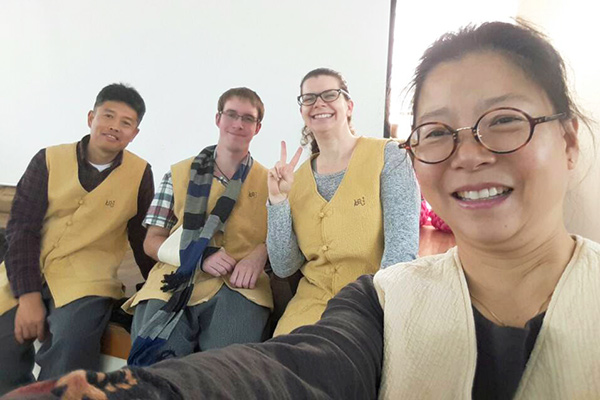
Templestay (sampling temple life) in Korea with foreign and native Korean friends.
What did a typical day look like?
In Korea I taught elementary and middle school students at several schools, and I went to a different school every day. But I never taught more than 20 “teaching hours” (40–45 minute blocks) per week, and no more than 40 hours per week (teaching hours + office hours). In Japan I taught ages 2–12, with 40 hours per week of actual teaching (preparation was done on my own time). I taught 2–4 year olds two mornings per week for 3 hours, and always taught ages 5–12 in the afternoons. One day a week I went to a local kindergarten and taught 3 different classes in the morning, and two days a week I had private lessons in the evenings. My weekends were always free.
Were there TESL/TEFL instructors from other countries at your school?
Yes! In Japan I worked with teachers from South Africa and the Netherlands. I was the only instructor at my schools in Korea, but there was another teacher in my village who taught at a few local elementary schools. He was from Canada.
Do you have anecdotes to share: small world occurrences, unexpected humor, places you explored?
I honestly can’t list all of the crazy, funny, interesting things that happened to me in Korea. It was an incredible experience and the culture is very different. For the most part, my experiences were good and the people were very friendly and kind. In Japan, I found the culture to be unique but more Western than Korea, so it felt a little more like home.
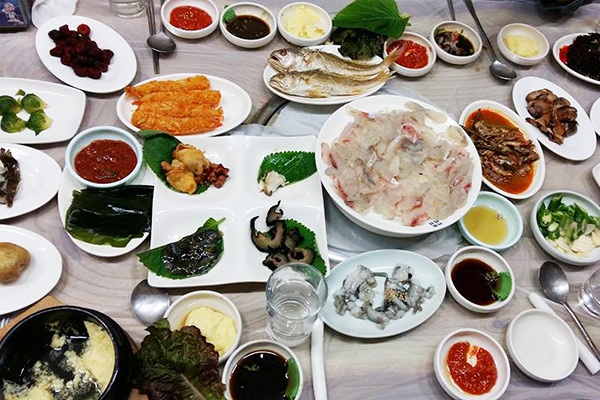
What dinner looks like in Korea.
How was the food?
I miss Korean food a lot! I’ll never forget the mudfish soup a local restaurant made — it doesn’t sound very appetizing, but it was delicious! I like spicy food so I adapted very easily to the food there. Unfortunately, I had a bad sushi experience in the U.S. years ago, so I’m not a big sushi fan. But I love onigiri (rice balls), and I have to say that the Japanese really know how to make good desserts. You can buy delicious eclairs everywhere, including every convenience store. I miss milk pudding, it was my favorite!
Asha the cat, born in Korea, now a U.S. citizen.
Tell us about some of the friendships you made.
I made incredible friendships in Korea that will stay with me forever. The other teacher who lived in my village became like my little brother, and we still talk. The Korean teachers that I worked with, and the Korean friends that I made, all have an open invitation to come stay with me in San Diego. They also became valuable resources when I applied to graduate school — all of my letters of recommendation came from my Korean coworkers. I even made a very unique friendship that followed me to Japan and then back to the U.S. — my cat, Asha, was born on a farm next to one of my schools in Korea. I also really valued my co-workers in Japan, who I still talk to, but I didn’t have as much time for socializing while I was there.
How long were you abroad?
I lived in Korea for a year and then in Japan for a year.
What are you doing now?
I’m back in San Diego for graduate school (I’ll be studying TESOL), and I’m working at an English school in Little Italy called Q International School. I love getting paid to do something I enjoy!
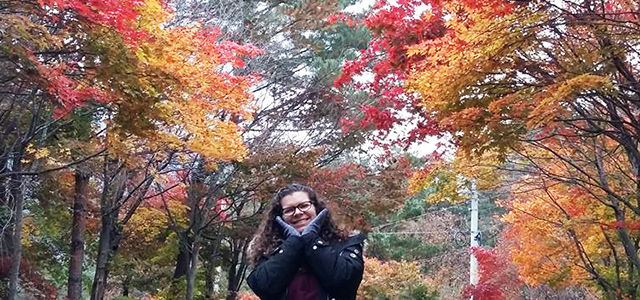
Autumn foliage in Injegun, Gangwondo, Korea.
What do you think are the biggest strengths of SDSU’s TESL/TEFL Certificate program?
The fact that all of the instruction is in-class makes a big difference; I was better prepared and had fewer problems because of it. The instructors are experienced and knowledgeable, and they can answer any questions you might have about the material you’re learning or the experience of teaching abroad. The evening program was also a huge factor in choosing SDSU’s ALI because I was working full time and my work schedule wasn’t very flexible. But the biggest benefit for me was the in-class experience requirement — learning by doing, with real students. My mentor, an ALI instructor, was very helpful and supportive, and I learned a lot from her.
Anything you’d like to add?
My life changed a lot after completing the program, and although my experiences abroad weren’t always fun, they were always interesting. I’ve grown so much as a person as a result of living and working abroad, and I’ve finally found a career that I feel passionate about. I owe part of that to the program director, the program coordinator, and the other ALI instructors for helping to prepare me to be a great EFL teacher.
When Saad Alajmi graduated from Al Jahra High School in June 2016, he decided to study in the United States and, after extensive googling, chose San Diego. “It has the best setting in America,” said Alajmi, who is from the town of Al Jahra in Kuwait, 20 miles west of Kuwait City.
Months later he landed in America’s Finest City for the start of the fall 2016 semester at SDSU’s American Language Institute. He enrolled in the English for Academic Purposes program, designed for students who plan to enter an American college or university at the undergraduate level.
Alajmi already had a command of the English language — students in his native country begin studying English in first grade — but he enthusiastically embraced his new opportunity to use it. “My favorite class is [Academic] Speaking because I speak English all the time,” he said. “The most I speak Arabic is with my friends and my brother.”
He also “really loves” his teachers. “They are really friendly and my two best teachers in ALI are Joel [Ortiz] and Elizabeth Osmund,” said Alajmi. “They are both funny and friendly and they smile all the time. They make the class fun with games and activities.” One example is the Kahoot! app, a game-based learning platform that makes it fun for students to see who can be the first to get the right answer.
Alajmi also took advantage of the free additional English-language support available to ALI students. “I was using the Homework Lab a lot for my essays,” he said. “It’s very helpful. I was asking the teachers for my mistakes.” Students can also benefit from the Pronunciation Clinic and the Grammar Lab.
Cultural immersion is another important aspect of the ALI, and Alajmi participated in many activities through the Student Life Office. He went to baseball games, football games, a community clean-up, and even fed the homeless downtown. Alajmi’s favorite outing was to the San Diego Zoo. “I saw animals I never saw before, like the panda and flamingo,” he said.
How does San Diego compare to Al Jahra? “The weather is mostly the same, but San Diego is much better because they have a lot of beaches and a lot of things to do,” said Alajmi. “The people are friendly and all the places are really cool. I like it.” After a pause, he added with a laugh, “I LOVE it. I’ve met people from all over the world and they’re really nice. It’s cool we can understand each other in English because we all have a different language.”
Alajmi graduated this summer from the ALI and, although SDSU was his first choice, he was accepted into Cal State Fullerton where he plans to major in computer engineering.
“I recommend ALI because it has a perfect location next to the SDSU campus … they have a lot of things to do … and I have great memories with my international friends,” he said. “They are from China, Japan, Vietnam, Korea, Taiwan, and Venezuela.”
Students at SDSU’s American Language Institute enjoy being on campus for a variety of reasons.
From the teachers at ALI to the lifestyle of San Diego to the activities available, there are plenty of ways to keep students happy during their stay in San Diego.
Natalia Mityushina
Natalia Mityushina from Russia has taken classes in ALI’s Intensive English for Communication (IEC), International Business English (IBE), and Social Entrepreneurship (SE) programs.
“I’ve met a lot of great people here,” she said. “The ALI has great instructors who have helped me a lot. I like the atmosphere. The teachers don’t only talk, they listen to what students have to say. ALI attracts wonderful, enthusiastic, and hard-working students who want to communicate as much as possible in school and out of school. It’s a fantastic learning community, where I want to study and work in the future. I’m lucky to be here.”
Hiroki Matsunaga
Hiroki Matsunaga came from Japan to study in the IEC program because he wanted to improve his English in order to become an airline pilot. He attributes his progress toward his goal to the teachers at the ALI.
“They are very kind,” he said. “When I have a question, the teachers will tell me what something means. They all answer me. I like it.”
The weather also appeals to Matsunaga.
“In Japan, the summers are very hot and the winters are very cold,” he said. “It’s very nice in San Diego. The weather is not hot or cold, it’s medium. It’s also a lot less dangerous here than in other American cities.”
Oleksandr Iakovenko
Oleksandr Iakovenko, a native of Ukraine, enrolled in the ALI’s Pre-MBA and Pre-Master’s program with hopes of one day obtaining his business MBA.
“The university here is very nice, especially the campus and the teachers,” he said. “The teachers are the best feature of the program; they are great. Everyone here is really kind and willing to help students.”
Yanying “Toto” Deng
Students also discover there are plenty of activities through the ALI. Chinese native Yanying “Toto” Deng came to improve her English through the IEC and IBE programs. Little did she know she would stay longer than planned to help improve other people’s lives by taking part in the first Social Entrepreneurship (SE) class at ALI, which focuses on creating businesses that solve social problems.
“We were like a family at the ALI,” she said. “We did a lot of things together. We went to lunch, dinner, hung out together, and traveled to Las Vegas.
“I really liked San Diego,” she added. “I felt very comfortable. I was able to have a more open personality in San Diego. The people were really friendly.”
Sofia Gonzalez
Sofia Rodriguez of Mexico came to the ALI hoping to improve her English speaking skills and expand her vocabulary through IEC and IBE. Not only did she improve her skills, she also found the SDSU community to be welcoming.
“I liked a lot of things about San Diego State,” she said. “But I think the best thing about it were all of the activities available on campus.”
In addition, Rodriguez found the San Diego community to her liking.
“San Diego is an awesome place,” she said. “Everything is nice … the weather, the people, the beaches. You can hang out with your family or friends. There are many interesting places to visit where you will have fun.”
Fadi Sassine
Fadi Sassine from Lebanon came to ALI at age 37 to improve his digital and internet skills through the IBE program.
“I like the entire family of SDSU,” he said. “You can go to the pool, watch kids play basketball, play football (soccer), or go to the gymnasium. It’s not only an educational institution, it’s a lifestyle.”
When Kyoung Seon Na attends Intensive English for Communication (IEC) classes at SDSU’s American Language Institute, the native of South Korea is always holding a baseball.
“It ain’t over till it’s over,” is written several times on the baseball, a saying made famous by former New York Yankees catcher Yogi Berra.
Na, who goes by the nickname “Anna,” is proof that something is never over until it’s over. At age 47, she is the oldest student attending the ALI.
Whenever she starts to feel down, she looks at Berra’s quote on the baseball. It immediately gives her motivation to face the rest of the day.
“I think baseball is life,” Anna said. “Like in baseball, we have so many chances. If we don’t give up, we always have a chance to win.”
Anna was recommended to the ALI by her son, a sophomore psychology major at SDSU who attended Torrey Pines High School north of campus while living with a host family. She believes she has hit a home run at the ALI because the IEC program will help her in three ways:
She’d like to help children learn how to speak English back home on Jeju Island, the largest island off the coast of the Korean Peninsula.
She wants to be able to speak English to the grandchildren she hopes to have one day.
An avid reader, she desires to be able to comprehend books written in English.
“The younger ALI students ask me why I study so hard when I already have a job back home,” said Anna, who taught Japanese and Korean before coming to America. “I tell them this is my last chance in life. It has been on my bucket list to study without working. I made it!”
While checking off an item on her bucket list, Anna continues to check in with her fellow classmates.
“Some of them tell me I’m the same age as their mom,” she said. “I have a close relationship with them, and even share Korean food. I enjoy talking with my younger classmates. It helps me understand what young people are thinking.”
Anna speaks fluent Korean and Japanese, as well as some Portuguese and Chinese. Because of that, she’s able to share with numerous ALI students in their native language.
“I love to study foreign languages,” she said. “Greeting other students in their language is my ice breaker.”
Since breaking the ice at ALI, Anna has made great strides in learning English. In fact, while being interviewed she proudly displays an “ALI Reading Award” she earned.
“I have very special and great teachers at ALI,” she said. “I have taught 25 years and love my job. The teachers here motivate me to study. I really appreciate them.”
Hyun Soo Kim of the Baltimore Orioles
In her spare time, Anna appreciates watching Major League Baseball in America. Her favorite player is Korean-born outfielder Hyun Soo Kim of the Baltimore Orioles.
“I love him because he is so positive,” Anna said. “He practices so hard and doesn’t give up. He motivates me in study and in life.”
Just like Hyun Soo Kim, who struggled to make the major leagues, Anna knows it’s never over until it’s over when it comes to improving in life.
When Hiroki Matsunaga heard about SDSU’s American Language Institute it was like music to the ears of someone who has played piano since childhood.
Not only would he learn English as he dreamed of becoming an airline pilot; he would also be close to the Mexican city of Tijuana.
“I want to study English somewhere that is very close to Mexico,” said Matsunaga, who’s enrolled in the Intensive English for Communication (IEC) program at the ALI. “If I want to be a pilot in Japan, I’ll have to pass a company exam. Then, I’ll have to pass a very difficult English exam.”
Since the age of 6, he has desired to be an airline pilot. Why?
“When my family was in an airport in Hawaii, I met an airline pilot wearing a suit,” he answered. “When he asked my name in English, my parents and grandparents had taught me to say, ‘my name is Hiroki Matsunaga.’ I was very impressed with the pilot and wanted to be like him.”
In order to be like the pilot, Matsunaga said it’s imperative that he do well during his two semesters at ALI. The IEC program is focused on speaking and listening, grammar, reading, and writing. IEC provides students the opportunity to practice their skills with teachers, American students, and classroom facilitators.
Before coming to America, Matsunaga was a junior at Sophia University in Tokyo with a Spanish major because of his interest in the Latin American culture and economy.
“In Japanese education, we learn grammar, reading, and writing,” he said. “We do not focus on speaking and listening like we do here at ALI. It has helped me a lot.”
He attributes his progress to his teachers at the ALI.
“They are very kind,” he said. When I have a question, the teachers will tell me what something means. They all answer me. I like it.”
Matsunaga also enjoys the weather in San Diego – much different than what he is accustomed to.
“In Japan, the summers are very hot and the winters are very cold,” he said. “It’s very nice in San Diego. The weather is not hot or cold, it’s medium. It’s also a lot less dangerous here than in other American cities.”
In his spare time, Matsunaga still plays the piano. He’s a big fan of the Japanese band “Sekai no Owari” (End of the World), which is famous in Japan and recently announced its plans to debut internationally with an English language album currently in production and expected to be released next year.
His other favorite pastime is baseball, which he played through elementary, junior high, and high school as an outfielder. While in San Diego, he attended a Major League Baseball game between the San Diego Padres and the Boston Red Sox at Petco Park downtown.
“It was very interesting,” he said. “The stadium is much bigger than the ones in Japan. The players are very powerful. They hit home runs very easily.”
By coming to San Diego and the ALI, Matsunaga has certainly hit a home run in his life.
Carissa Baird, graduate of the TESL/TEFL teacher training program at SDSU’s American Language Institute
“What did I get myself into?!” was Carissa Baird’s first impression upon arriving in Riyadh, Saudi Arabia in 2013 to teach English as a second language. By the time she left, six months later, she would write on her blog:
From the expats to the locals, fellow teachers and students alike, I have experienced some of the most genuine kindness I’ve ever come across in my life … I’ve received countless gifts and other expressions of gratitude and kindness from people I’ve only known a few months, sometimes just a few hours. I’ve been invited to their homes, their workplaces, and their social gatherings. If they cannot offer you food, they will always be ready with a smile, a greeting, a kiss. Their generosity is compelling.
“The TESL/TEFL teacher training program at the ALI [SDSU’s American Language Institute] opened me up to a world that I didn’t even know existed,” said Baird. “Teaching English was just going to be a means for travel at the time I started, but I realized that it provided so much more. Not only have I been able to work and travel both domestically and abroad, but this certification made me realize that I LOVE teaching as a profession, and now I’m pursuing my master’s degree in TESOL (Teaching English to Speakers of Other Languages). The program at ALI put me in touch with some great people, including my assigned mentor who I still seek out for advice now, three years later.”
Baird shares her journey from trepidation to exhilaration:
Where did you go to school and how did you find out about the TESL/TEFL Certificate program at SDSU’s American Language Institute?
I graduated from San Francisco State University in 2010 with a B.A. in art with an emphasis in art history. In 2012, I heard about teaching English as a second-language and researched programs to obtain my teaching certificate. I enrolled in the ALI program in spring 2012 and completed it 11 weeks later. I was a facilitator in the ALI classes for a few months until I got my first job teaching abroad.
How did the program’s free worldwide job placement assistance work?
I would receive emails from Van [Hillier, program director] about teaching opportunities and apply for the ones I thought might be interesting. When the email for Saudi Arabia came through, I just thought … WHY NOT!? How many people do you meet that can say they lived there? So I went for it out of sheer curiosity and potential bragging rights. (And the money was good). Also, before I left, they put me in touch with another teacher that was also going, so it was nice to have someone else along for the ride.
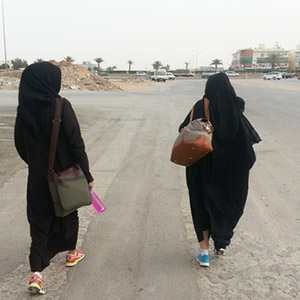
Baird (left) and another ESL teacher in Saudi Arabia walking to the main road from their apartment, on their way to the DQ — Riyadh’s Diplomatic Quarter. (“It was the only compound where we could run/exercise outside, without having to wear an abaya,” said Baird. “Note our running shoes, haha!”)
How soon after completing the program were you teaching English abroad?
Six months, however it could have been a lot sooner if I’d pursued it more aggressively.
Where did you live?
The company I worked for arranged our housing and had us staying in our own apartments, which was basically a long-term-stay hotel out in the middle of nowhere. We weren’t on a compound or anything. Our housing was paid for but we didn’t have a choice as to where/what it was.
What did a typical day look like?
Be picked up by a driver in a van full of other female teachers at 7 a.m. and be taken to Saudi Electronic University to start classes at 8 am. (There’s no mass transportation other than taxis, and women aren’t allowed to drive, so transportation was provided by the company.) When I first started I had only one class per week, but as time went on I had more and more classes both at the original school and then at Princess Nora University. Classes — with all female students — were about 2-4 hours long, depending on the class, and levels ranging from beginning to advanced.
Some days, toward the end of my stay, I would teach two or three classes and then go to my private tutoring classes in the evenings. (Which is exhausting after a full day of regular classes, but a good way to make extra cash.) But staying busy in Saudi Arabia was a blessing, as there wasn’t much else to do. After school, the driver would come back to pick us up and then drop us off at home, making several stops along the way since not all the teachers lived in the same place. Usually we would stay home after that, making dinner, watching TV, sleeping, or whatever.
KSA [Kingdom of Saudi Arabia] wasn’t too accommodating when it came to entertainment or other recreational activities, especially for single, Western women without family nearby. Going to the mall or the grocery store was a common outing, or any events that the foreign embassies were putting on in the evenings, which were lifesaving, but hard to get into.
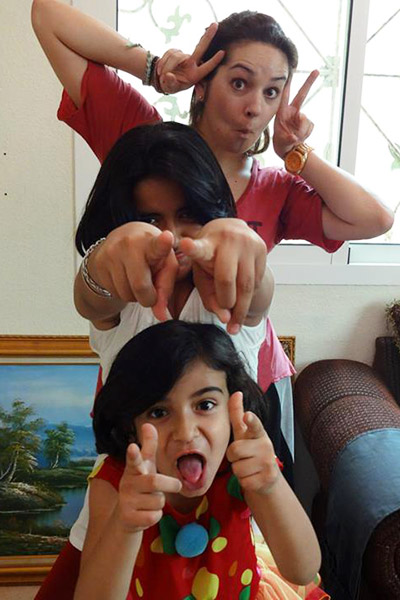
Baird with two of the four children she tutored privately in Saudi Arabia. (“I don’t have many photos from teaching in Saudi Arabia because the women weren’t allowed to take photos of their faces,” said Baird. “So mostly you get photos of their hands forming ‘peace’ signs. Children are allowed to be shown because they haven’t hit puberty yet and aren’t required to cover up.”)
Why were foreign embassy events hard to get into and what kind of events were they?
Saudi Arabia is a “dry” country, so there is no alcohol or bars. Also, there are no movie theaters or live music/concerts (secular music) or dancing venues. A lot of the entertainment options we take for granted here are practically non-existent there, unless you have a hook-up at an embassy. The foreign embassies were like an underground social scene for expats in KSA. There were bars, live concerts, dancing and DJs, special dinners and festivals, etc. BUT to get into them, you usually had to have someone directly involved with the embassy to “sponsor” you, which basically meant they’d vouch for you to be allowed in, understanding that you wouldn’t do anything stupid. When you entered the event you had to be on a list, show a valid passport, check your cell phone at the door (no pictures allowed), then go through a physical screening process — metal detectors, etc. — before being allowed in. Once inside though, it’s like Pleasure Island from Pinocchio!
Were there TESL/TEFL instructors from other countries at your school?
Yes, there were instructors from the USA, the UK, Scotland, and even from Saudi Arabia, Jordan, and Oman. I’ve also met instructors from Australia and India.
Do you have anecdotes to share: small world occurrences, unexpected humor, places you explored?
Oh my gosh! I could go on and on about these things! Living abroad for the first time was insanely difficult in the beginning, but incredibly rewarding in the end. The cultural exchange and personal growth, as well as friendships that come out of it are invaluable. I have too many stories, but I’ll direct you to my blog: carissasade.tumblr.com.
An excerpt:
I met a guy in Saudi Arabia who happened to be staying at my hotel (although we weren’t really allowed to speak to each other) who was from San Diego, received his TEFL at ALI, went to school in San Francisco at the same time I was there, and then took his first job teaching abroad in Saudi with the same company as mine. We ended up becoming great friends and traveling together a lot. After losing touch for a year or two, we ran into each other again in San Diego, teaching at the same language school! SMALL WORLD INDEED!
How was the food?
Food in Saudi Arabia, when you can find the authentic stuff, is great! I really liked the traditional Saudi dish kabsa which is basically meat, rice, and sauce — but with lots of spice and flavors! Something typical that the girls would bring to class is Saudi “coffee,” which was basically cardamom tea that I grew accustomed to, but didn’t like at the beginning! This was usually accompanied by dates — a staple in the country — and lots and lots of sweets, candy, cakes, etc. Also, grape leaves stuffed with olives and drenched in olive oil were delish! However, it seemed that the more “popular” places to dine were American restaurant chains, ironically! Applebee’s and a cheesy Italian place called Pietto’s were hot spots. But sometimes when you’re craving a little bit of home, this was nice.
Tell us about some of the friendships you made.
Gosh, I’ve made a lot of great friends both with colleagues and students alike over the past few years. In Saudi Arabia, I made great friends with a few teachers — male and female — that I got to travel with a lot while we were there, to Dubai, Sri Lanka, and Bahrain. The students I’ve had at the schools I’ve taught at in the U.S. have had such a significant impact on me. I still talk to many of them even now, almost two years later, and they tell me about their marriages, their moves to other parts of the country, and their newest educational and professional endeavors. (Facebook is a wonderful tool in this field of work!)
What do you think are the biggest strengths of SDSU’s TESL/TEFL Certificate program at SDSU?
Taking a similar class right now, I have to say that the SDSU program completely surpasses it on so many levels. I liked the support both in and out of the classroom, and I enjoyed the variety of instructors whose strengths were highlighted in different presentations throughout the program. The variety in teaching and learning new strategies was so awesome! It was great to be able to learn straight from the experts of specific aspects involved in ESL teaching. Also, being able to schedule and observe classes at the ALI was so great! In the class I’m in now, we have to go out and try to find our own classes to observe, which can be grueling. The ALI program was very hands-on and helpful in finding me a job after the program, even if it was as a facilitator there at SDSU. I felt very prepared.
Where are you pursuing your master’s in TESOL and where would you like to teach?
CSU-Fullerton. I’m hoping to obtain this master’s to have the ability to teach at a community college or university here in California, however I might have it in me to go abroad once again! Not sure where, but the possibilities are endless and that excites me!
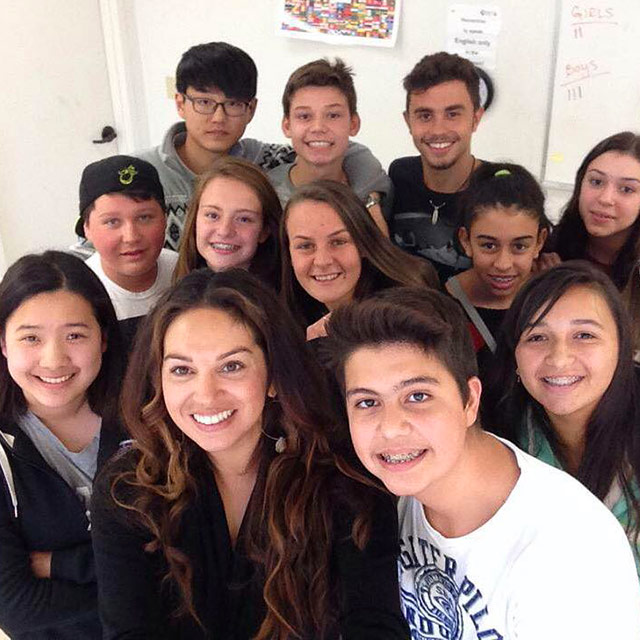
Baird and her students at International House – San Diego, a private language school in Fashion Valley where she worked after returning from Saudi Arabia.
Who was your mentor during the SDSU program and why do you still seek out him out for advice three years later?
Ken Levin was my mentor and yes, I still contact him from time to time, and even just meet up for coffee every once in a while! He’s great for intelligent conversation about the field and excellent advice. I’ve even had him help me out by writing recommendation letters for both graduate schools and professional opportunities. He’s always been super supportive and able to relate to the wacky world of international work.
Anything you’d like to add?
Teaching English has introduced me to some amazing people from all over the world that I’ve formed lasting friendships with — students, co-workers, and administrators. There’s a whole world of people that ESL teaching has opened me up to, with endless opportunities, and I’m so grateful that I fell into this amazing community! I really hope this helps and inspires anyone who is looking to go down this road. It seriously brings tears to my eyes and so much joy to think about what this little certificate has brought to my life! I’ve lived more in the last few years than most people have in their lifetimes and I’m thankful to TESOL for providing me with the confidence and means to pursue these otherwise overlooked opportunities. Travel and teaching are two passions I never thought would guide my life’s path, but now, I can’t think of any other way. Thank you to ALI for being the catalyst to this life of adventure!
For more information on the 130-hour TESL/TEFL Certificate program at SDSU Global Campus, visit ali.sdsu.edu/teslteflcertificate
San Diego State University’s American Language Institute (ALI) is part of SDSU Global Campus, whose motto is “Never Stop Learning.”
ALI student Fadi Sassine is a perfect example of the slogan.
At age 37, the Lebanon native came to ALI a month ago to improve his strategic digital and internet skills through the International Business English (IBE) program.
“I came here for the essence,” Sassine said. “You should never stop learning.”
Sassine studied business and economics at Lebanese University. He spent the next 14 years in Kuwait, five years in the banking industry and nine as a advertising director for the BBDO Advertising Agency.
He had vacationed in California two years ago and thought San Diego would be a perfect place to study.
“We lacked digital and internet skills in the Middle East,” Sassine said. “I decided to resign and go study English to improve my content and writing skills in parallel with the technical. I needed to write English every minute. I wanted to improve myself, which is what I believe in.”
He discovered SDSU and the ALI through a Google search.
“I like the entire family of SDSU,” he said. “You can go to the pool, watch kids play basketball, play football (soccer), or go to the gymnasium. It’s not only an educational institution, it’s a lifestyle.”
After finishing his education in San Diego, Sassine will have the option of either going back to any of the Gulf Cooperation Council (GCC) countries or Lebanon.
“As a digital marketer, there are a lot of opportunities,” he said. “Generally, whatever you learn and bring from the West can be an added value to any local or international corporate place.
Sassine said he really enjoys the mild weather in San Diego compared to the “microwave” of Kuwait. He also likes American food such as hot dogs, hamburgers, french fries, ice cream, and chocolate.
Most of all, he’s happy to be learning skills necessary to the higher-management level.
“You should always learn and improve yourself, regardless of your age,” he said. “Life can change quickly.”
Natalia Mityushina came to SDSU’s American Language Institute for the first time in 2012 at the advice of her mother’s friend in San Diego, who told her how wonderful of a place it is to live.
Natalia certainly did enjoy the area and her education during her two months of studying Intensive English for Communication (IEC) to improve her English and find a good job in her hometown of Moscow, Russia.
Little did she know that, a little more than two years later, she would be back at the ALI in the International Business English (IBE) program after working in Russia’s financial world.
“I wanted to make changes in my life,” she said. “I wanted to study business in a U.S. university. I needed a lot of preparation to be accepted.”
Natalia started back at the ALI in January 2015 with IBE. When that session ended, she heard about the new Social Entrepreneurship (SE) program and wanted to give it a try. The SE program focuses on creating businesses that solve social problems.
“Some of my classmates were involved and liked it,” she said. “I tried it and loved the program.”
The SE program taught her the importance of helping other people. “SE showed me how people can be more successful in business and how you can help improve lives throughout the world,” she said.
Natalia’s proposed SE project was to one day open a fitness school for people who had never tried it before, remembering how it was when she first went to a gymnasium and felt out of place.
She also took the Pre-MBA and Pre-Master’s programs in hopes of building up her resume to obtain a Ph.D. in business through an American university. Natalia just completed the TESL/TEFL (Teaching English as a Second Language/Teaching English as a Foreign Language) program with hopes of one day teaching English to non-native speakers either in the U.S. or abroad.
“Non-native speakers come with a lot of issues in English,” she said. “Learning English is important. I want to be able to help them.”
Natalia added that the ALI has been of significant help to her.
“I’ve met a lot of great people here,” she said. “The ALI has great instructors who have helped me a lot. I like the atmosphere. The teachers don’t only talk, they listen to what students have to say. ALI attracts wonderful, enthusiastic, and hard-working students who want to communicate as much as possible in school and out of school. It’s a fantastic learning community, where I want to study and work in the future. I’m lucky to be here.”















 His other favorite pastime is baseball, which he played through elementary, junior high, and high school as an outfielder. While in San Diego, he attended a Major League Baseball game between the San Diego Padres and the Boston Red Sox at Petco Park downtown.