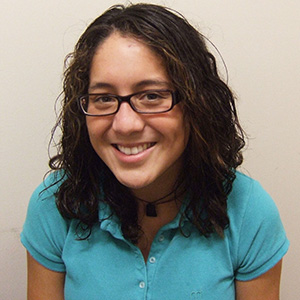
Many American Language Institute (ALI) students attend classes to improve their English and better their chances to enroll to the main campus of San Diego State University (SDSU). In 2008, Raquel Munoz Ruiz enrolled in English for Academic Purposes (EAP) classes and studied for two semesters. She then enrolled for one semester in Intensive English Communications (IEC) program courses. She applied to main campus and was accepted into SDSU and is currently majoring in biology with an emphasis in zoology.
Where are you from?
I’m from a city called Santa Cruz in Bolivia.
How long have you been at SDSU?
I came to the U.S. about two and a half years ago. I attended the ALI, then took classes at another school, and then applied to SDSU.
Why did you choose SDSU?
I love San Diego and for my major I wanted to go to SDSU. My dream job is to work at the zoo. My goal is to be a herpetologist. My father is one and my mother worked with snakes for 25 years, so it runs in the family. I like snakes and lizards. I eventually want to earn my Ph.D.
Where is your favorite place to eat?
I have a few but on campus I have a new favorite, Las Casitas. There are so many restaurants in San Diego that I like, I also enjoy eating Korean and Vietnamese.
What is your favorite thing about San Diego?
The weather and the beach. There’s no place like San Diego, there is so much diversity here. You see people from all over the world, so you don’t have to travel far to meet people from other countries. I also love that it’s laidback here.
Have you made many friends here?
A lot! I play tennis and that helps. I play sports and I’ve learned a lot about the culture from sports. I learned to surf, box, wakeboard and I play soccer too. I surf in La Jolla. My perfect weekend is surfing. There is no ocean in my country, but here there are so many beaches. I go to the beach all the time.
In a very diplomatic way, Zhenis Kalibekov would love to see his son, Alisher, follow in his footsteps. Zhenis is the Republic of Kazakhstan’s diplomat to China, following four years as his country’s diplomat to Russia.
As Zhenis was recently taking part in an English interview, his son sat intently listening to all that was said. Alisher does not speak English, but he plans to perfect the language through the EAP program.
“This is a big step for my son,” Zhenis said. “He is very proud to be accepted by the American Language Institute. He’ll take English, get to a high level and choose where he will go. I want my son to help people and his country.”
The EAP program will help Alisher develop the skills needed to succeed at a U.S. university. He will most likely learn English for one year at SDSU, and then go to either Harvard or UCLA to study international law.
Alisher actually preceded his father, who is based in Beijing, by one year in China. The son studied Mandarin in China for two years before graduating in July. According to his father, Alisher studied Chinese for 13 hours daily from 8 am-9 pm.
“He was one of the best students in the school,” his father said. “In China, the rules are very tough. He knew nothing when he went to China; but he liked it. In a short time, it was necessary for him to communicate with the Chinese people.”
Why did Alisher leave China to enroll at SDSU? Bill Price, executive director of the ALI at SDSU, was the executive vice president at the now defunct OSULA Education Center when Zhenis studied there a decade ago. Zhenis remembers Price as being “the best friend of all the students when I studied in Los Angeles,” so he was only too happy to send his son to be under Price’s direction at the ALI.
“Dr. Price was always giving good suggestions and advice,” Zhenis said. “As students, we could always speak openly to Dr. Price. He gave me good direction to go to Russia as a diplomat. Now that I’m in a high position as a diplomat, I’m very proud of it and very proud of Dr. Price.”
Zhenis is also very proud of his son for coming to SDSU as a way of learning English and eventually becoming a diplomat. “Being a diplomat is very interesting,” Zhenis said. “I now have the knowledge to protect my citizens and companies in foreign countries. I tell my son to get a good education and use it in a professional field.”
Many students come to the American Language Institute to improve their English so they can move on and be successful at the university level. One student, Xie Baifan, is studying English so she can study to be a filmmaker at San Diego State University. After learning English at the ALI, Baifan applied to SDSU’s master’s program and was admitted to the Television, Film,and New Media (TFM) department in fall 2011. We caught up with Baifan and talked about her ALI experiences and what her goals are for the future.
Where are you from?
Changsha, Hunan, China. I earned my bachelor’s degree in Media and Communications at Zhejiang University.
How long have you been at SDSU?
About nine months – I arrived at the end of August 2010. I spent two semesters in the EAP program and now this semester I’m an IEC student.
Why did you choose SDSU?
A friend of the family lives in San Diego and she suggested SDSU since she went here and loved it.
Where is your favorite place to eat?
I love the Thai restaurant across from campus, and I like the restaurants on Convoy street – and 99 Cent Ranch, but I mostly cook for myself.
What is your favorite thing about San Diego?
The beaches, no doubt. Coronado is my favorite and then La Jolla.
Have you made many friends here?
I made American friends making a video, and Korean, Brazilian and Japanese friends.
How did your time at the ALI help you prepare for going to main campus, SDSU?
Before arriving, I couldn’t speak an entire sentence of English. The environment here is so helpful. The ALI teachers taught me so much – especially Lind and Rebecca. They helped with my application submission to SDSU graduate school.
What do you plan on doing with your degree?
Well, I want to learn American media and I want to be a filmmaker. There are not many female filmmakers in China so that is my goal.
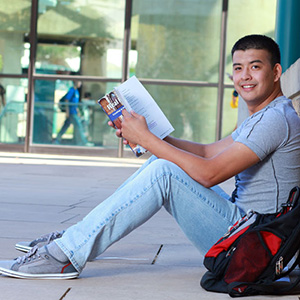
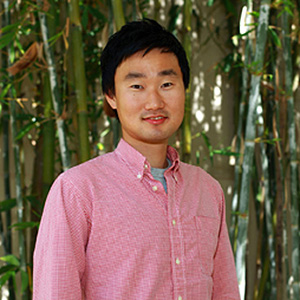
The ALI supports the concept of study combined with outside activity in order to practice classroom lessons in the real world. Our students take what they learn and apply it to everyday situations like playing sports or exchanging opinions in informal gatherings.
“When I play basketball and tennis the atmosphere here is really different from Korea. Like when we play in Korea we play with strangers, so we just play. That’s it. But in America we say ‘Hello’ to each other and ‘Hey what’s your name’ and we talk. It’s very good since I’m an international student and it allows me to talk in English. It’s helpful when trying to make American friends,” says ALI student Dohwan Lee.
“Because of American personalities they really want to help me. They want to speak. Americans don’t really like silence, but in Korea we are accustomed to silence. If I say hello to strangers they would think I’m strange. But in America, saying ‘Hello,’ ‘Good morning’ and whatever to strangers is fine. I have become accustomed to the American lifestyle thanks to my time at the ARC.”
Lee was so happy by the advantages of using his Aztec Recreation Center (ARC) membership (one of the benefits of being a student at the ALI is that you receive a free membership to the ARC) that he was inspired to write an English essay about his experiences. His essay, “Get Rid of Stress” points out the obvious – regular visits to the gym protects and reduces your chances of many ailments – but he also includes his many chances to meet American friends by playing basketball and tennis, and even engaging in small talk while sitting in the hot tub.
The benefit of outside-the-classroom activities is not lost on Lee who mentions why he now believes that students should exercise as well as focus on studies. “When I was in high school and middle school in Korea my class started at 7 am and ended about 9 pm. Students spend time doing assignments and homework. Americans, I feel make time to enjoy their leisure time and play sports like surfing and snowboarding and this helps with studies. It’s really different. I want to come back to America when I have children. I want them to see and experience Americans enjoying life with exercise and studying.”
Lee learned a very important lesson: He not only improved his health by outside activity but also improved his English by interactions at the gym with Americans, where there is a monthly average of 15,000 ARC active members, providing plenty of opportunity for foreign students to meet and speak with American students in a fun and healthy environment.
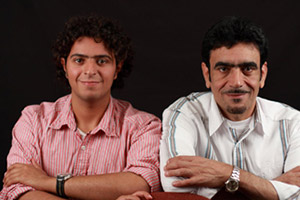
From Saudi Arabia to San Diego – Faisal and Ghusson Azizs
In a home in Saudi Arabia last year, a father (Ghusson) and son (Faisal) were both excited and nervous. Faisal’s acceptance letter to study in the U.S. had arrived. That excitement turned to total shock, when Faisal got the good news — he was accepted to be a part of the 2010 San Diego State University American Language Institute (ALI) English program.
The ALI has been teaching students for many years. It has welcomed many students from over 115 different countries for 37 years; however, it has never had two generations of family members attend the same program. Until now.
“I knew he was applying to schools, but I had no idea he applied to SDSU. When he told me I couldn’t have been more proud,” says Ghusson. “And when I told Faisal I went to SDSU in the 80s, well he was surprised.”
“Yeah, I was shocked. I couldn’t believe it was the same school. He started telling me about where he lived and other small things like how to pronounce ‘El Cajon.’ My father told me before I came here, ‘Don’t say El Ca-joan,” laughs Faisal.
Ghusson and Faisal recently reunited (Faisal has been in the U.S. for several months) on SDSU’s campus and discovered that yet their experiences in the classroom were very similar, the surroundings changed a bit. “The campus is completely different, but the beautiful garden is the same,” Ghusson explains. “It’s very emotional – I’m happy I can share a good education with my family. I knew ALI’s culture and they are like a family and my son is in safe hands.”
They have done a lot during their visit. Faisal showed his father downtown, which is something Ghusson hadn’t seen during his time in San Diego, and they spent some time at the Bay. Faisal has an American roommate and his family mentioned that when his father came to town that they all should go out to dinner. So they did. Faisal adds, “My roommate’s family lives in San Diego, so they all spoke about San Diego 30 years ago and mentioned things we didn’t know.” All agreed it was a great night of learning, sharing, and making new friends.
When father and son discuss their first day in the U.S., Faisal says that his first day was memorable to say the least, “I was like a little kid who went into a toy store where he’s just exploring the place, watching everything. I had never been to the U.S. before so everything was like a dream, a new experience.”
Ghusson mentions that the city’s reputation extends around the world. “San Diego is a beautiful city, and ALI and SDSU have a great reputation in Saudi Arabia. SDSU is known to provide an excellent education.”
The conversation continues and switches to learning English, and Faisal chuckles about how his English has changed since arriving at the ALI, “If we had this conversation when I first came here, we’d probably be here for two hours just so I could explain myself. My roommate helps me when I have difficulties, especially writing.”
Faisal also provides advice for those who are studying English. “I tell my friends that sometimes I don’t have a problem communicating [English] with people. By the end they will understand what I’m trying to say. Start thinking in English, don’t think in Arabic. When you wake up in the morning, don’t think in Arabic, ‘I will go take a shower, get my coffee, and go to school.’”
So what does the future hold for Faisal? Well, his father has an answer for that, “I want my son to earn a degree and come back home of course. Use his knowledge he learns here, since he is getting a good English education. I haven’t used my English in probably 15 years, and as you can see I can still speak English. It shows you I got a good education.”
Today, Ghusson is back in Saudi Arabia and Faisal is planning to pursue a degree at an American university in business administration. As for the ALI, it will be here when Faisal decides to send the third generation of Azizs to learn English at SDSU.





 The ALI supports the concept of study combined with outside activity in order to practice classroom lessons in the real world. Our students take what they learn and apply it to everyday situations like playing sports or exchanging opinions in informal gatherings.