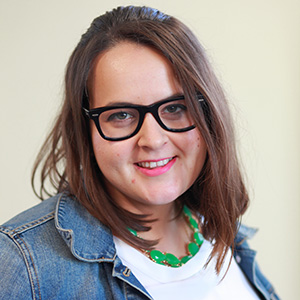

ALI Student Profile – Natalia Mityushina

Natalia Mityushina
Natalia Mityushina
Natalia Mityushina

Natalia Mityushina came to SDSU’s American Language Institute for the first time in 2012 at the advice of her mother’s friend in San Diego, who told her how wonderful of a place it is to live.

Natalia certainly did enjoy the area and her education during her two months of studying Intensive English for Communication (IEC) to improve her English and find a good job in her hometown of Moscow, Russia.

Little did she know that, a little more than two years later, she would be back at the ALI in the International Business English (IBE) program after working in Russia’s financial world.

“I wanted to make changes in my life,” she said. “I wanted to study business in a U.S. university. I needed a lot of preparation to be accepted.”

Natalia started back at the ALI in January 2015 with IBE. When that session ended, she heard about the new Social Entrepreneurship (SE) program and wanted to give it a try. The SE program focuses on creating businesses that solve social problems.

“Some of my classmates were involved and liked it,” she said. “I tried it and loved the program.”

The SE program taught her the importance of helping other people. “SE showed me how people can be more successful in business and how you can help improve lives throughout the world,” she said.

Natalia’s proposed SE project was to one day open a fitness school for people who had never tried it before, remembering how it was when she first went to a gymnasium and felt out of place.

She also took the Pre-MBA and Pre-Master’s programs in hopes of building up her resume to obtain a Ph.D. in business through an American university. Natalia just completed the TESL/TEFL (Teaching English as a Second Language/Teaching English as a Foreign Language) program with hopes of one day teaching English to non-native speakers either in the U.S. or abroad.

“Non-native speakers come with a lot of issues in English,” she said. “Learning English is important. I want to be able to help them.”

Natalia added that the ALI has been of significant help to her.

“I’ve met a lot of great people here,” she said. “The ALI has great instructors who have helped me a lot. I like the atmosphere. The teachers don’t only talk, they listen to what students have to say. ALI attracts wonderful, enthusiastic, and hard-working students who want to communicate as much as possible in school and out of school. It’s a fantastic learning community, where I want to study and work in the future. I’m lucky to be here.”

Program Spotlight: Social Entrepreneurship Students Hold Fundraiser to Help People Worldwide

Social Entrepreneurship Fundraiser

Social Entrepreneurship FundraiserAccording to Paloma Gouveia, “the thing we need most now in the world is compassion.”


A Brazilian student in the groundbreaking Social Entrepreneurship (SE) certificate program at SDSU’s American Language Institute, she was among 20 classmates who spread compassion during the summer semester.

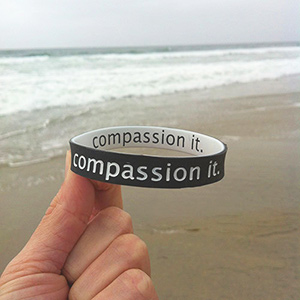
Through the selling of Compassion It bracelets, the SE students raised $1,000 to help the following individuals make their dreams become reality:

  • A farming woman in Armenia growing fruits and vegetables
  • A single mother in Colombia developing her own clothing shop
  • A fisherman in the Philippines buying additional nets and accessories for his boat
  • A woman in Kenya purchasing a dairy cow

“If I explain to someone what social entrepreneurship is, I will use the Compassion It fundraiser as a perfect example,” Gouveia said. “You care about others, think about good actions, and share all the love you have. In doing so, you help others live their lives in a better way.”

Sara Schairer, founder of San Diego-based Compassion It, provided the bracelets at a reduced cost for the SE students’ fundraiser. Her organization is a nonprofit global-social movement that inspires compassionate actions and attitudes.

The Compassion It bracelets are intended primarily for fundraisers. At an affordable cost, communities, schools, businesses, and even families can raise money using the bracelets,  influence positive behaviors through a pass-it-on ripple effect, and have an impact of peace and mindfulness that affects everyone.

All money for the initial purchase of wristbands is recycled back into Compassion It operations and programs, including compassion education, communication efforts, and, of course, producing more wristbands that will travel the globe.

The four gifts provided by the SE fundraiser were made possible through Kiva, a nonprofit organization whose mission is to connect people through lending to help alleviate poverty. Kiva enables individuals to lend as little as $25 to create opportunity around the world.

Students participating in the SE fundraiser were from Brazil, Columbia, Italy, Japan, Saudi Arabia, South Korea, Taiwan, and Turkey.

The Compassion It bracelets were black on one side and white on the other. Students began the day with the bracelet showing its black side. Once they performed a compassionate act, they would flip their bracelet from black to white. Compassionate acts included volunteering, providing food/money to a homeless person, helping an elderly person across the street, placing coins in a parking meter that was almost expired, sending someone flowers, and taking a fellow classmate to the airport, among other things.

“In the history of mankind, too many people just answer the world’s problems by saying, ‘who cares?’” noted Italian student Matteo Marchisio. “Now, social entrepreneurship gives a possible way to stop this thinking.”

Kelly Shah, ALI social entrepreneurship program director, said the summer fundraiser took place for several reasons: providing students with social involvement, practicing English with a purpose, the business aspect of learning to pitch an idea, and having a real-life occurrence.

“We were looking for something outside of the classroom to provide a great experience for our students,” she said.

The SE program focuses on creating businesses that solve social problems. A prime example is TOMS Shoes, which matches every pair of shoes purchased with a pair of new shoes for a person in need.

Students are each creating a project along social entrepreneurship lines. For instance, Gouveia enjoys photography and is putting together a website to sell her photos, with part of the profit being donated to animal institutions and zoos. Marchisio has developed a plan to sell a sci-fi book he has written with a portion of the income being donated to a foundation focused on fighting illiteracy.

“I studied TOMS Shoes and really appreciated the organization’s attempt to help people,” he said. “I am trying to fight a social disadvantage and help people who need it.”

ALI Student Profile – Yanying “Toto” Deng

Yanying Toto Deng
Yanying Toto Deng
Yanying “Toto” Deng

Chinese native Yanying “Toto” Deng came to SDSU’s American Language Institute to improve her English through the Intensive English for Communication (IEC) and International Business English (IBE) programs.

Little did she know she would stay longer than planned to help improve other people’s lives by taking part in the first Social Entrepreneurship (SE) class at ALI, which focuses on creating businesses that solve social problems.

After spending 15 months in San Diego, Toto left in early June to complete the final year of her master’s degree in cross-cultural communications at a Japanese university. Then she will head into the working world in corporate communications and continue her SE work through volunteer cross-cultural programs.

While at the ALI, she showed her entrepreneurial spirit by organizing a multi-cultural event for more than 100 students from local community colleges and universities. Among the countries represented were Brazil, Japan, Saudi Arabia, Africa, Switzerland, Turkey, and Mexico.

During the festivities, Toto played a Chinese guitar, known as a pipa.

“It’s really a special instrument,” she said. “I played it to introduce my culture. The people in Japan were interested when I played it there, too.”

The event was among many reasons Toto believed it was special to have stayed at ALI four extra months to take part in the first semester of the SE program.

“We were like a family,” she said. “We did a lot of things together. We went to lunch, dinner, hung out together, and traveled to Las Vegas.”

Always the adventurous and outgoing type, Toto first began displaying her personality early in elementary school. She was selected by her second-grade teacher to emcee an event on campus.

“She picked me and asked me to speak loudly,” Toto said. “I didn’t feel afraid. I became the emcee for two years at our school.”

The Beijing native continued her education through high school in China, then moved to Tokyo as an undergraduate to major in business management. She finished the first of two years working toward a master’s degree in Japan before coming to the ALI to learn English.

“My English has improved a lot since I came here,” she said. “Some of my teachers say it is a miracle for me. My goal was to study English so I would be able to work for an international company and be able to travel the world focusing on speaking and communication.”

Toto hopes to be an organizer in the entertainment business, perhaps helping develop commercials for the Internet. When that happens, she will fondly recall developing her skills at the ALI.

“I really liked San Diego,” she said. “I felt very comfortable. I was able to have a more open personality in San Diego. The people were really friendly.”

Being friendly is a trait that certainly matches her personality.