
Teaching English Abroad Addresses Trifecta of Interests for Graduate of SDSU’s TESL/TEFL Program

Chandler Marshall with some of her students.

In preparation for a study abroad program in her senior year at San Diego State University, Chandler Marshall made a few visits to SDSU Global Campus, through which the program is administered. It’s there that she saw an American Language Institute flyer for Teaching English as a Second Language, which spoke to all her interests — her lifelong desire to teach, and her passion for travel and experiencing other cultures.

“I went home and did some online research,” said Marshall. “Soon after, I went and spoke with my counselor to get an overview of the program. She gave me a lot of information and contact to the ALI assistant director of teacher training.”

Shortly after graduating with a B.A. in social science, Marshall enrolled in the TESL/TEFL certificate program, choosing the accelerated daytime schedule — four weeks of intensive study. “It was so fun and informational that the time actually went by very fast,” said Marshall. The 130-hour certificate program also has the option of 11 weeks of nighttime courses.

“This program is one-of-a-kind and one of the best decisions I could have made after graduating from SDSU,” said Marshall. She answered a few questions about the program, and her experience teaching English in Japan.

Kindergarten 1 class.

How did the TESL/TEFL program’s free worldwide job placement assistance work?
The worldwide job placement assistance is one of the best benefits of the TESL program through the ALI. I never expected to get so much help and support from a program as I did from the TESL/TEFL certificate program coordinator, the program director, and the rest of the professors. The team does an amazing job of being available to help and guide you in the direction that is best suitable for you. Throughout the program, the instructors give you a ton of information on locations, cultural differences, salaries, and all else you would need to know prior to living and teaching abroad.

After graduation, the directors and professors from the ALI are so helpful and supportive. I went into the office many times to meet with the program coordinator and he would have brochures, and contact information for jobs in the location I was interested in. Since I wanted to work in Japan, and the program coordinator actually lived in Japan for many years, he had many recommendations. Not only that, but he would constantly check in to see how the job hunting was going and to offer more ideas. On top of that, they are able to write letters of recommendation when I was applying to jobs. They continue to frequently send other job offerings and information on events that are good to attend for future work.

Snowy day fun in Japan!

How soon after completing the program were you teaching English abroad?
I completed the program in August 2016, and I moved to Japan in June 2017. I wanted to stay in San Diego for around a year after completing and take my time in the job hunt.

What made you choose the country you chose?
The main reason I wanted to live in Japan was I wanted to experience an extreme culture difference. Japan is an amazing country in so many aspects. The level of respect that the Japanese people have toward one another as

well as their country was very interesting and exciting to me. I knew from the start I wanted to teach in Asia. After doing the TESL program, it was solidified that I wanted to work in Japan. I met many incredible students from all over the world, but I really admired my Japanese students and all that they had to say about Japan as a whole.
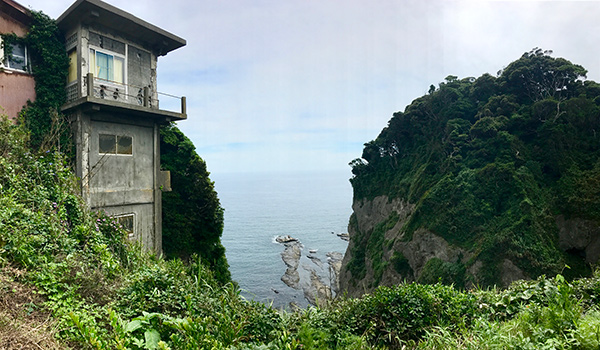
Utsunomiya, Tochigi, where Chandler Marshall lived while teaching abroad.

Where did you live?
I lived in the Tochigi Prefecture. The city I lived in was Utsunomiya, which is the capital of Tochigi. It’s a short 50-minute Shinkansen (bullet train) ride to Tokyo.

What did a typical day look like?
I worked for a private school where the program coordinator was good friends with the owner/boss. Two times a week I would have Baby Class (2–3 years old) from 9 am–12 pm. I would get to the school anywhere between 7:30/8 am to set up and prepare. Every day from 12–2pm I had a lunch break/time to lesson plan or prepare for classes. From 2:20–4:30 pm I taught my kindergarten class (5–6 year olds). From 4:30–6:30 pm I taught an elementary class (7–8 year olds). Once or twice a week I had an evening class until 7:30. These kids were ages 9–12 depending on the class or week.

Were there TESL/TEFL instructors from other countries at your school?
I worked at a small private school so the teachers I taught with were from America. In Utsunomiya, I met many expats/TESL instructors from all over the world.
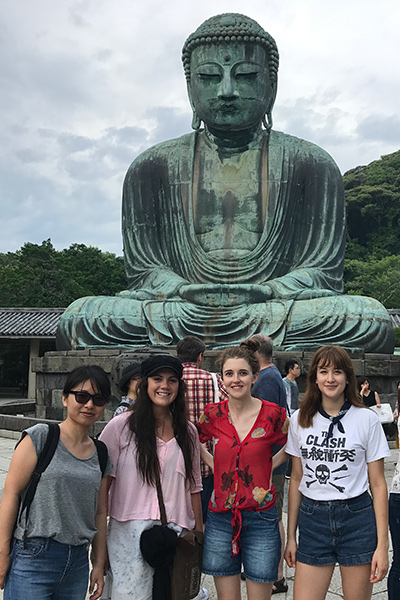
The Great Buddha (“Daibutsu”) of Kamakura is one of Japan’s most fascinating historical landmarks.

Do you have anecdotes to share: small world occurrences, unexpected humor, places you explored?
Something that was amazing to me was the level of respect in Japan. For example, no one talks on their phone on the trains out of respect for others who may want to sleep or just simply want it quiet. Also going up and down escalators was so intriguing because everyone stays on the left side so that if people want to walk, they have plenty of room on the right side. Also ALL THE VENDING MACHINES WERE LIFE SAVERS! Haha. They have sodas, teas, coffees, espresso, flavored waters, and even hot drinks in vending machine all throughout the country. You can’t walk more than 100 meters without running into a vending machine. Which is great because anytime you’re thirsty or need some coffee, the drinks are super accessible. (They even have some with beer and alcohol.) I explored many parts of Japan as well as many other countries in Asia. We had a good amount of time off, which made it very easy to travel and see what Japan and other countries in Asia had to offer.

How was the food?
The food is absolutely amazing. Options are endless when it comes to food in Japan. Whether you want an amazing sit-down restaurant, to street food/street markets, they have it all. People in Japan truly take pride in their food and very rarely did I have a meal that I wasn’t completely impressed with.

Tell us about some of the friendships you made.
I made many lifelong friendships here in Japan. First off, I have a wonderful relationship with my boss and we plan to stay connected throughout the future. On top of that, the teachers I worked with were great and friends that I will have forever. Outside of work, I met many amazing people from all over. I have friends who are from Japan, and friends who are teaching here as well. Its something really special to teach abroad and meet people you would never get to meet otherwise. These friends truly impact your experience and will be lifelong friends.

How long were you abroad, and what are you doing now?
I was here in Utsunomiya for a year. Though I could have renewed my contract, I will be heading home because there are some big family events happening in the near future. I am looking into other teaching jobs in Asia as well as Europe for the 2019 year. I know that I will return to Japan at some point in the near future and this country holds a special place in my heart.
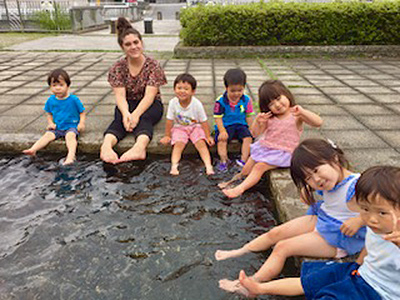
Marshall with summer school students.

What do you think are the biggest strengths of the TESL/TEFL Certificate program at SDSU?
I truly don’t think there is another program like the one at SDSU. It is so hands-on when it comes to observing and actually teaching in the classroom. On top of that, you have a new lesson daily on either English or how to teach English. You also present a lesson at the end of the week to show what you learned, and get constructive criticism to help for the future. It’s very unique compared to many certificates because it isn’t online and you get to practice in front of professionals and people who have been doing this for many years. Not only that, but post TESL certification, you receive so much support and help that can be very hard to do on your own. Which makes it so much easier to find the perfect job for yourself. This program is one-of-a-kind and one of the best decisions I could have made after graduating for SDSU.


ALI Instructor Profile – Theresa Perales

Theresa Perales
Theresa Perales
Theresa Perales

Theresa Perales, an instructor at SDSU’s American Language Institute (ALI), is always on the move.

“I like to stay active,” she said. “I am constantly doing something.”

She runs up to 10 marathons or half-marathons annually and works out every day whether it be running, yoga, spinning, you name it.

“It’s just who I am at this point,” Perales said. “Whether or not I got enough sleep or am tired, I am out the door running or doing yoga. It’s like how we all just eat or breathe. I just do.

“I love running. Once I get out there, I get a running high. There is no coordination involved. I am only competing against myself.”

When it comes to running, it all goes back to when she was a student at SDSU several years ago. She cheered on friends one day at the yearly Rock ‘n’ Roll Marathon in San Diego then said to herself it was time to do the same.

Ironically, Perales was not into athletics while she attended University of San Diego High School (now Cathedral Catholic.) She focused solely on academics, taking advanced classes in preparation for college.

Perales went to SDSU, earning both undergraduate and master’s degrees in Spanish. While attending her master’s program, she went to the Rock ‘n’ Roll marathon to cheer on friends and had her life turned around from exclusively focusing on academics to including a multitude of athletic adventures.

Raised by her grandparents, she was also adventuresome while growing up. Her grandparents loved to hop in the RV and take summer trips to such places as the Great Lakes region, Ohio, and Buffalo, N.Y.

The travel bug stayed with Perales in college as she twice participated in study abroad programs to Costa Rica. She took her boyfriend (now fiancé) on the second trip, hoping to show him a place where they may someday retire.

During her time at SDSU, she enrolled in ALI’s TESL/TEFL Certificate program that prepares novice instructors to successfully live and teach English overseas. She became a facilitator (teacher’s aide equivalent) at ALI in 2008 and has been teaching since.

Perales currently teaches in the EAP (English for Academic Purposes), Intensive English for Communication (IEC), and TESL/TEFL Certificate programs. This summer, she is also working as the Fulbright pre-academic program coordinator for an exclusive group that comes to SDSU in August. The three-week Fulbright training program through ALI is designed for students from countries other than the U.S., and is formatted to introduce them to American culture, university standards, and fair practices.

Working with international students is one of the main reasons Perales enjoys the ALI, which is located close to main campus. She welcomes being able to take her students across the street to meet native-English speakers.

“I like the students first and foremost,” she said. “I love their diversity. Working at the ALI, I have the opportunity to grow in so many different ways.”

Perales and her fiancé, both fans of the San Diego Padres and Chargers, are about to grow in another way as they have become first-time homebuyers. They are do-it-yourselfers when it comes to home improvement projects and working on their cars.

She had a Chargers key chain at the old residence but realizes the team could soon be headed to Los Angeles.

“I don’t want them to leave,” she said. “If they do, I don’t want to be stuck with that key chain.”

Unlike the Chargers, she has no plans of leaving her current employment location any time soon.

Alan Ng, English Teacher in China | ALI TESL/TEFL Program

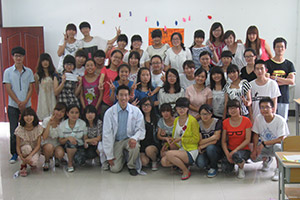
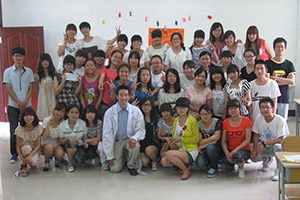
Alan Ng's Class in China

Alan Ng - ALI TESL/TEFL graduateAlan Ng decided to enroll in the TESL/TEFL program at the ALI because he wanted certification and to become more qualified to teach English abroad. He chose SDSU because of its excellence as a university, close proximity to his home, and the opportunity to learn from real professors in a classroom setting.

Before studying at SDSU, Ng held a number of varied and interesting jobs – security guard (he was the guy in the red polo short who inspected your bag at Petco Park, Qualcomm Stadium, and Comic- Con), YMCA summer camp counselor, Target backroom associate, dining host at Sea World, and clinician.

As much as he enjoyed his numerous positions, he wanted to travel abroad and teach. Ng’s most recent jobs have been teaching positions in China. He has spent the last two years working at a medical school called Jilin Medical College in Jilin City as the foreign expert teaching oral, writing, and reading classes to medical majors of all kinds. His current teaching job is as an English teacher at Dalian Maritime University in Dalian, China.


ALI TESL/TEFL Program
Successfully live and teach English overseas. Over 100 TESL/TEFL Certificate graduates have been employed in over 40 countries with the help of ALI’s job placement assistance program. Learn in a combined format – solid teaching with hands-on practical classroom experience. Program Highlights and Goals

  • Worldwide Job Placement Assistance
  • Lesson Strategies and Plans
  • Teaching Strategies
  • Technology
  • Language Acquisition


Program Highlights
For me, the highlights of ALI’s TESL/TEFL program was being taught by qualified professionals who had years of experience under their belt. I also appreciated having the opportunity to go into a real ESL classroom in the afternoon and observe professors in action, watch how they interacted with students, and discover the activities they used and the methods they employed. I can truly say that having the opportunity to “be in the field” or “trenches” of the ESL battlefield helped me a lot when I went overseas to start my own job as an English teacher.

I have to tip my hat off to my mentor during my TESL/TEFL formation period. I learned a lot seeing how he ran his classes, how he organized his content and delivered his lesson plans. I actually “stole” many of the activities he used and implemented them in my own classes in China to great success. Of course, I am also indebted to all the other fine teachers at ALI as well.
I also had a lot of fun meeting the foreign students who came to ALI, working with them and learning about their backgrounds. I met many nice students from Japan, Korea, China, Italy, Germany, Turkey, and Saudi Arabia during my time as a TESL/TEFL student.

Program Setup
I think what makes ALI’s TESL/TEFL program unique is the way they set up their classes. For four hours you study the theory of second language acquisition and are given an overview of how language teaching has evolved through history. In the second half of the class, you go into a real ESL classroom with your mentor and can work with him and his students for four weeks. I thought that was very cool, having the balance of theory plus practice. Also, bringing in different professors with different specialties is nice. I also liked how at the end of the program you get to teach a class of your own and get filmed while doing it. It’s a great way to put everything you have learned throughout the four weeks into practice.

Classmates, Homework, and Instructors
My experience with the TESL/TEFL program was great! I loved it. All of my classmates were nice and friendly and we got along together well. The homework was reasonable and not too much. The instructors were top-notch and very informative. Also, studying on the beautiful SDSU campus is always a bonus and having the different dining options like cafeteria or outside restaurants was enjoyable.

Simple Advice
Well, from the program director the advice was “Keep things simple stupid!” or KISS, and “Make class doable and full of success.” I still strive to follow these principles everyday while teaching my students. I also have now learned to “Keep the students moving,” and to draw them out with games and physical activities. Don’t let them settle into their “territories.” Also, have a movie playing in the background when the students walk in. Find ways to engage your students, physically if possible, to keep their attention and interest. Incorporate variety into your class and sprinkle in some total physical response (TPR), if possible.

Job Opportunities

I did not utilize the ALI instructors to help me find a job abroad, as I was fortunate enough to land one on my own via the Internet. My target country was China and after trying several recruitment agencies I learned that the “official” Chinese policy for hiring English teachers was that you needed to have two years of experience before a school could hire you. However, I was lucky enough to get into a Catholic Volunteer program called Maryknoll that had a “China Teacher Program” for recent college grads. With my newly acquired TESL/ TEFL certification from SDSU and bachelor’s degree, I was an ideal candidate for them and broke into China that way. I have been working here ever since.

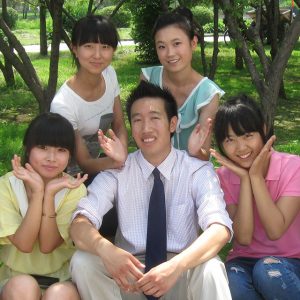
Alan Ng's Class in ChinaChina
I took a family vacation to China three years ago after I graduated from college and went to many cities like Hong Kong, Guangzhou, Guilin, Xi’an, Beijing, and Shanghai. During one of our tours, the tour guide told me that job opportunities were plentiful in China and that one could get a job easily if one had a bachelor’s degree. Since I had just walked on the Great Wall of China, saw the Terra-Cotta warriors of Xi’an and the beautiful rivers of Guilin, how could I pass up an opportunity to live in this country with 3,000 years of history and culture?

It was after this family vacation to China that I enrolled at ALI’s TESL/TEFL program.

I have had a blast these past two years working in China. Not only have I gained valuable teaching experience but I have made lifelong friends, both Chinese and non-Chinese. The people you meet when you travel abroad will be some of the most interesting that you will encounter in your life. The Chinese students are some of the most respectful and hardworking you will ever meet. They are also very helpful and will come to your aid whenever you have problems. China in general is undergoing massive changes as it attempts to modernize and climb out of its third-world country status. Yes, there are the glamorous cities of Beijing and Shanghai but that’s a small slice of the country. The rest of China is not that wealthy or developed. The average monthly salary of the Chinese in my former city Jilin is 3,000RMB or $476. Imagine living off of that money in the U.S. It’s impossible, yet that is roughly how much money the average person makes in Jilin City.

With regards to social structures, much revolves around the single child, since families are only allowed one child and most of my students did not have siblings. (There are exceptions of course. If you are from a farming family, are an ethnic minority or both of your parents are single children then they are allowed to have more than one).

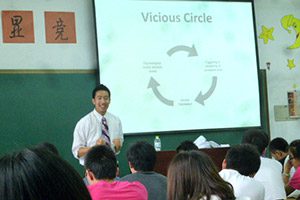
Alan Ng teachingLiving abroad in China has been an enriching experience for me personally as I have learned how to live on my own in a foreign country, speak a new language, and adapt to a new environment. I guess this is another point worth mentioning and another benefit of teaching EFL abroad: If you want to become fluent in any language, move to the country that speaks that language. Obviously, this is nothing new, but after living this for two years I can attest to its accuracy. While I was living in Jilin City, no one but a small fraction of people in my social circle spoke English. As a result, whether I was taking a taxi, shopping at a mall, ordering food at a restaurant or watching a movie, I had to speak Chinese to accomplish the task. I was able to use the language every day with native speakers and have my pronunciation and output corrected by them.

Consequently, my spoken Mandarin has improved tremendously after two years. My brain forged tons of new neural pathways to understand Putonghua (Mandarin) and is still etching new ones in at the moment. This is another perk of living abroad and teaching English in any country, if you’re serious about it, not to mention how you will personally grow living in a totally new culture. The way you view yourself and think about yourself will also change as people operate differently and treat you differently as a foreigner.


Alan Ng in Dalian ChinaDalian, China
Dalian is a major city and seaport in the south of Liaoning Province. It is the southernmost city of Northeast China and China’s northernmost warm water port, at the tip of the Liaodong peninsula. Today it is considered a financial, shipping and logistics center for Northeast Asia and has had a significant history of being used by foreign powers for its ports (the British, Russians and Japanese all occupied the city at one point).

  • EFL Teaching Methodologies
  • Resume Assistance
  • ALI Recommendation
  • Reflective Teaching
  • Teacher-Mentor